
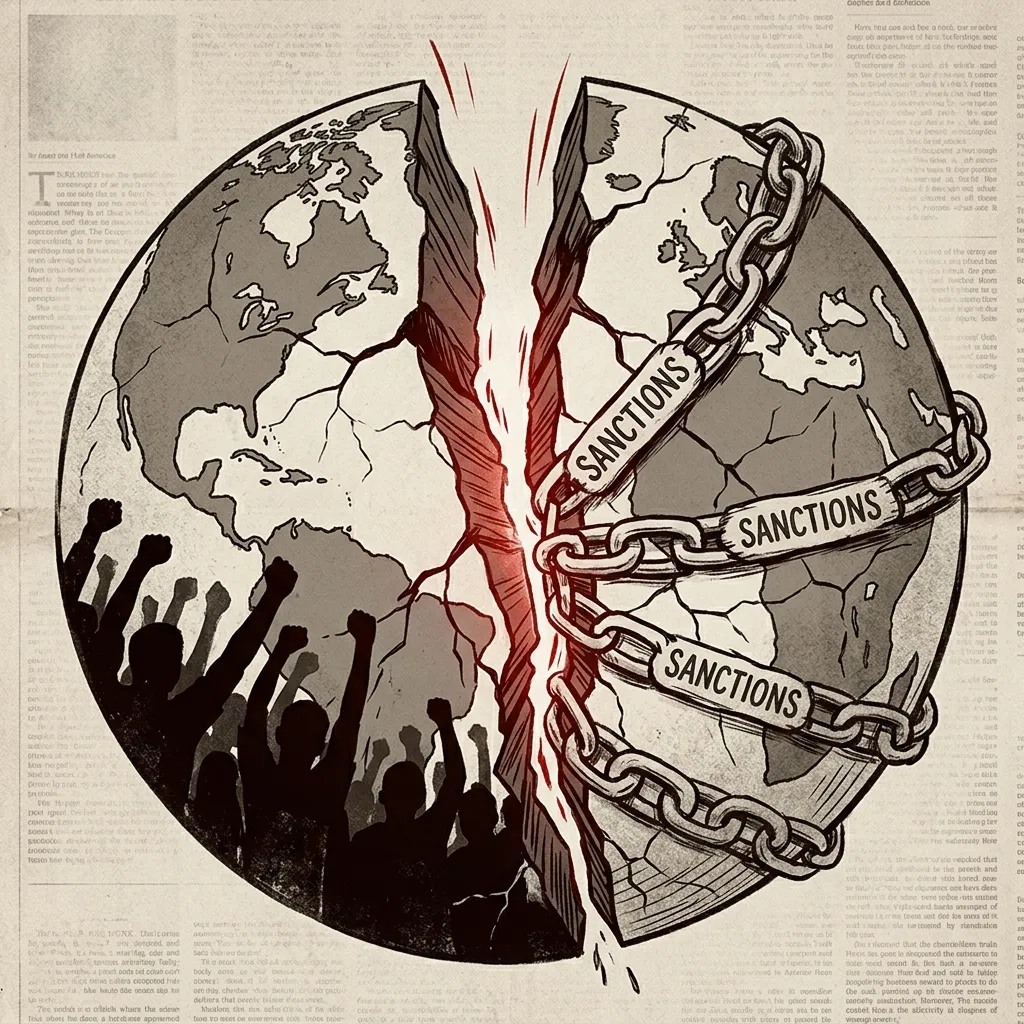
Cuban officials have forcefully condemned a new round of U.S. sanctions announced by President Donald Trump, labeling the measures a form of 'collective punishment' against the Cuban people. The criticism was delivered during May 1 labor marches, which saw public demonstrations against the U.S. policy. The sanctions target individuals involved in broad sectors of the Cuban economy, escalating a decades-long economic embargo that has defined relations between the two nations.
The Hindu provides historical context, noting that Cuba has been under a nearly continuous U.S. trade embargo since Fidel Castro's communist revolution in 1959. The report mentions that President Trump has previously mused about taking over the island nation, which lies approximately 145 kilometers from Florida. This framing situates the new sanctions within a long-standing geopolitical conflict, emphasizing the endurance of the U.S. embargo as a backdrop to the current escalation.
Al Jazeera focuses on the immediate diplomatic rejection from Havana, reporting that the Cuban government has 'firmly rejected' the recent sanctions. The outlet's headline and content highlight the Cuban characterization of the measures as 'collective punishment' directed at the populace. This framing centers the human impact and the government's defiant stance, presenting the action as a direct punitive measure against Cuban society rather than a targeted policy.
Le Monde offers specific details on the sanctions' scope, reporting they were enacted via an executive order on May 1 and target individuals operating in 'energy' and 'defense' sectors, among other wide-sweeping areas of the economy. The report confirms that Cuba's foreign minister used the term 'collective punishment' to describe the new measures. This European perspective provides procedural and sectoral specifics, framing the event as a calculated policy announcement timed with international Labor Day.
Clarin, a Latin American source, frames the development as increasing pressure on Cuba. It notes the U.S. position that the island 'continues to represent an extraordinary threat.' The report highlights that the announcement coincided with marches in Havana where thousands of people demonstrated in front of the U.S. embassy. It quotes the Cuban chancellor's response: 'They are not going to intimidate us.' This regional framing emphasizes the atmosphere of confrontation and the direct mobilization of Cuban citizens in response to the U.S. action.
Framing the Conflict The sources converge on Cuba's official denunciation but diverge significantly in context and emphasis. The Hindu and Le Monde provide deeper structural context—the former with the historical embargo and Trump's past statements, the latter with the legal mechanism and economic sectors targeted. Al Jazeera and Clarin focus more on the present-day reaction and rhetoric, with Clarin uniquely highlighting the public marches at the U.S. embassy. The U.S. justification, cited explicitly only by Clarin, portrays Cuba as an ongoing national security threat, a viewpoint not explored in depth by the other reports.
In conclusion, the reporting illustrates a consistent narrative from Cuban authorities rejecting the sanctions as a broad attack on its citizens, set against the enduring U.S. policy of isolation. The regional framings differ in whether they prioritize the historical arc of U.S.-Cuba relations, the technical details of the sanctions, the immediate diplomatic clash, or the on-the-ground public response. These differences underscore how the same event is contextualized within distinct editorial lenses, from South Asian historical analysis to Latin American regional solidarity and Middle Eastern focus on geopolitical condemnation.