
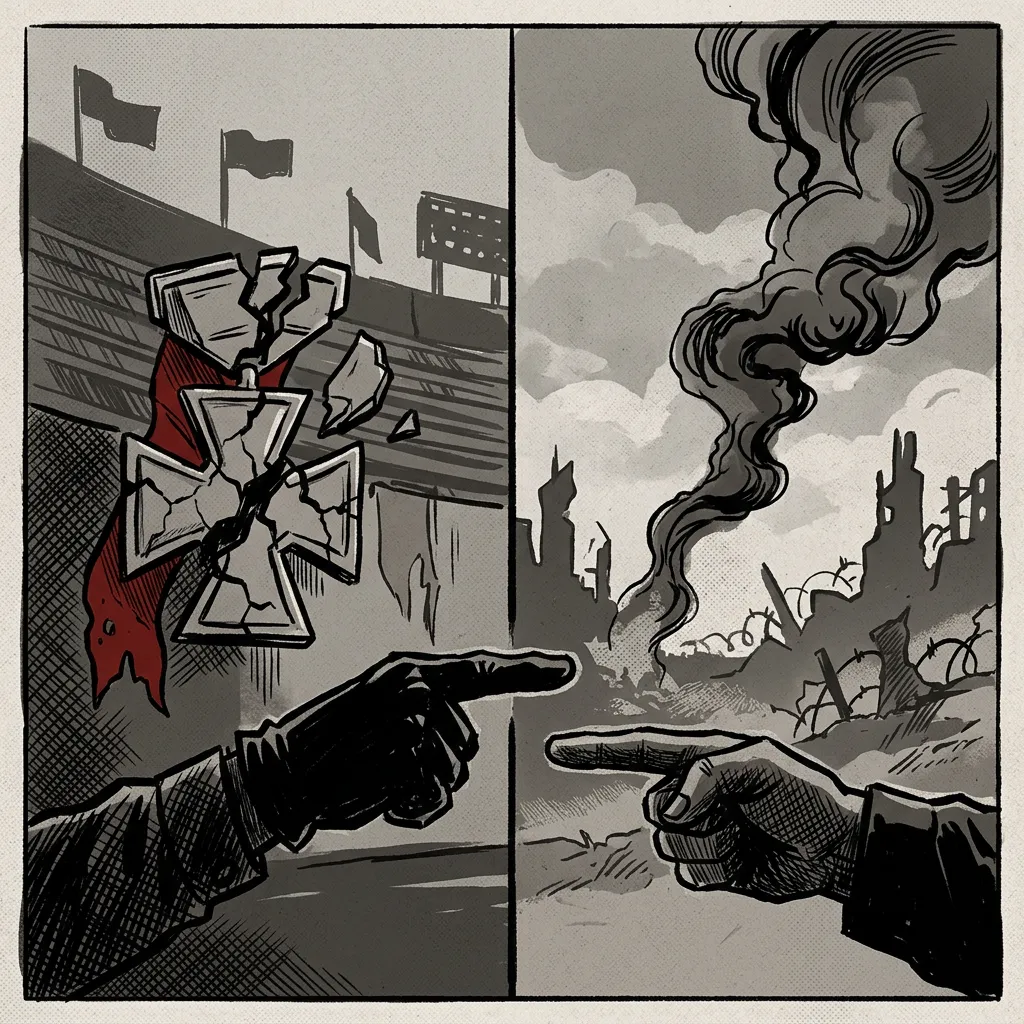
In the lead-up to Russia's annual Victory Day celebrations, a unilaterally declared ceasefire has collapsed into a new round of mutual recriminations and military strikes. Russian and Ukrainian authorities are trading accusations over who violated the temporary truce, while Moscow tightens security and restricts media access for its signature WWII commemorative parade.
The Ceasefire and Conflicting Claims
The Russian government declared a unilateral ceasefire set to last from midnight on May 8 through the end of May 9, a period encompassing its Victory Day commemorations. According to reports from the independent Russian outlet Meduza, the Russian Defense Ministry stated that all its troop formations fully ceased combat operations at the designated time. However, the ministry claimed that Ukrainian forces continued to strike, recording over 1,365 alleged violations in what it terms the "special military operation" zone. In response, the ministry said its forces launched what it described as "retaliatory" strikes against Ukrainian artillery, command posts, and drone launch sites.
Ukrainian President Volodymyr Zelensky presented a starkly different account. In an address reported by Meduza and Reuters via the Daily Maverick, Zelensky asserted that Russia made no genuine attempt to halt fighting. He stated that Ukrainian forces had recorded more than 140 artillery strikes, 10 assault operations, and hundreds of drone strikes overnight. Zelensky characterized the Russian ceasefire declaration as demonstrating "strange and inappropriate" logic, a point echoed by The Hindu, which reported that Ukraine lambasted Russian leader Vladimir Putin for wanting a pause only to stage a grand parade. Ukraine did not officially join the ceasefire.
Escalating Strikes and Security Measures
As the ceasefire nominally took effect, Meduza reported that Ukraine launched a mass drone attack on Moscow. Moscow's mayor stated that 27 drones bound for the capital were shot down, causing no casualties or damage. The Russian Defense Ministry claimed a total of 264 drones were destroyed over various Russian regions, and reported strikes on infrastructure like a refinery in Yaroslavl. In turn, Russian authorities repeatedly warned that continued Ukrainian attacks would trigger a "devastating" strike on the center of Kyiv.
Concurrently, Moscow implemented unprecedented security and media restrictions for the Victory Day parade. Meduza reported, citing the German publication Der Spiegel, that Russian authorities revoked press credentials for all foreign news outlets covering the Red Square event—a first in the parade's history. A Kremlin representative told Der Spiegel that "due to the current situation, the format of parade coverage has been changed," allowing only Russian media. Kremlin spokesman Dmitry Peskov later denied that any credentials were stripped, stating a limited number of journalists, including from international outlets that regularly cover the president, were accredited. The parade itself will be held in a reduced format without military hardware for the first time since 2007, with mobile internet cut off in Moscow on May 9 for security.
Framing the Conflict and Commemoration
The reporting reveals a fundamental clash in narratives surrounding both the current conflict and the historical commemoration. Russian state-aligned media, exemplified by RT, frames Victory Day as a global event honoring the Soviet Union's immense sacrifice in defeating Nazi Germany, a role it claims is being deliberately obscured in the West by bans on Soviet symbols. This historical narrative is presented separately from the current hostilities.
In contrast, Ukrainian and independent reporting directly links the commemorations to the ongoing war. Sources like The Hindu and Daily Maverick frame the Russian ceasefire as a cynical ploy tied solely to Putin's desire for an unimpeded parade, not a sincere peace gesture. The independent Russian outlet Meduza weaves the two threads together, reporting on the battlefield accusations alongside the extraordinary security lockdown in Moscow, implicitly connecting the threat of Ukrainian drones to the scaled-back, tightly controlled nature of the celebrations.
Broader Implications
The events highlight the deepening entrenchment of the conflict. The failure of the unilateral ceasefire—and the diametrically opposed accounts of its violation—underscore a complete absence of trust or functional communication between the warring parties. The severe media restrictions and scaled-back parade in Moscow illustrate how the war has reshaped even the most sacrosanct domestic rituals in Russia, turning a celebration of past military triumph into an event overshadowed by present-day vulnerability. Meanwhile, Ukraine's dismissal of the truce and its continued strikes demonstrate a strategy of rejecting any Russian-imposed timelines or conditions, asserting its agency even on symbolic dates central to the Kremlin's historical identity. The divergent reports on the ceasefire's first hours serve as a microcosm of the wider information war, where even the basic facts of who fired first are contested, leaving the international audience with parallel, irreconcilable realities.