
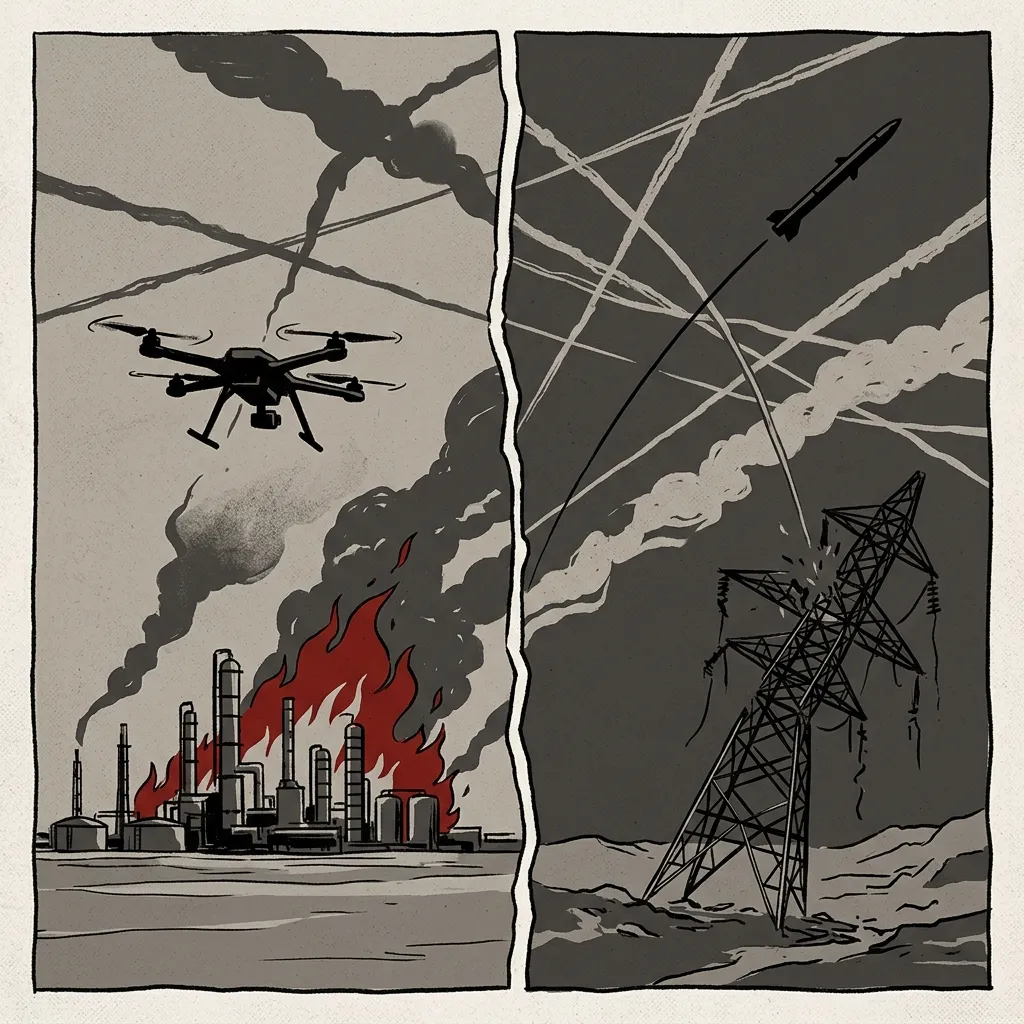
Recent weeks have seen a marked intensification of aerial attacks between Russia and Ukraine, with both sides focusing their efforts on damaging each other's energy infrastructure. This mutual escalation has resulted in casualties, fires, and significant environmental concerns.
A broad overview from The Hindu notes that both Kyiv and Moscow have increased their aerial campaigns in recent months, with energy infrastructure serving as a primary target for both militaries. The report frames the situation as a reciprocal cycle of strikes.
Specific incidents illustrate this pattern. In the early hours of April 28, a facility in the Russian port city of Tuapse was hit. Reports from the region describe drone debris striking an oil refinery, sparking a major fire. The operational headquarters for Krasnodar Krai, the region containing Tuapse, stated there were no casualties from this specific incident. However, the city's mayor urged residents living near the facility to evacuate to a temporary shelter set up in a local school.
Independent Russian media outlet Meduza provides detailed reporting on the aftermath in Tuapse. It cites environmental observers describing enormous black smoke columns over the city and a strong smell of burning. A correspondent for an environmental outlet reported that some residents had become desensitized to the odor, which carries health risks, and noted black streams, potentially petroleum products, in the local river. The report also contextualizes this as part of a series of attacks on the Tuapse refinery since mid-April. It details a previous incident where a fire burned for four days, leading to what was described as an environmental disaster involving 'oil rains,' severe air pollution, and contaminants washing into the sea. The outlet notes that local authorities were accused of downplaying the scale of that earlier event.
The BBC frames the Tuapse strike as the 'third Ukrainian strike' to hit a Russian oil refinery, highlighting a pattern of Ukrainian deep strikes. Its reporting includes the Kremlin's accusation that these attacks by Kyiv are aimed at destabilizing global energy markets. This introduces a geopolitical and economic dimension to the tactical military action.
While the sources agree on the basic fact of a refinery strike in Tuapse, they differ in their emphasis and sourcing. Meduza's account is heavily focused on the local environmental and human impact, drawing from independent Telegram channels and environmental observers. The BBC's report centers on the strategic pattern of Ukrainian attacks and the Russian government's official response. The Hindu provides a higher-level, symmetrical summary of the escalating tit-for-tat dynamic.
The conflict's aerial dimension is not one-sided. The Hindu's report references explosions in Kyiv, indicating that Russian forces are conducting similar strikes on Ukrainian energy infrastructure. While the provided sources do not detail specific Ukrainian casualties or damage from recent Russian attacks, the framing establishes that both capitals are engaging in this form of warfare, contributing to a broader cycle of escalation.