
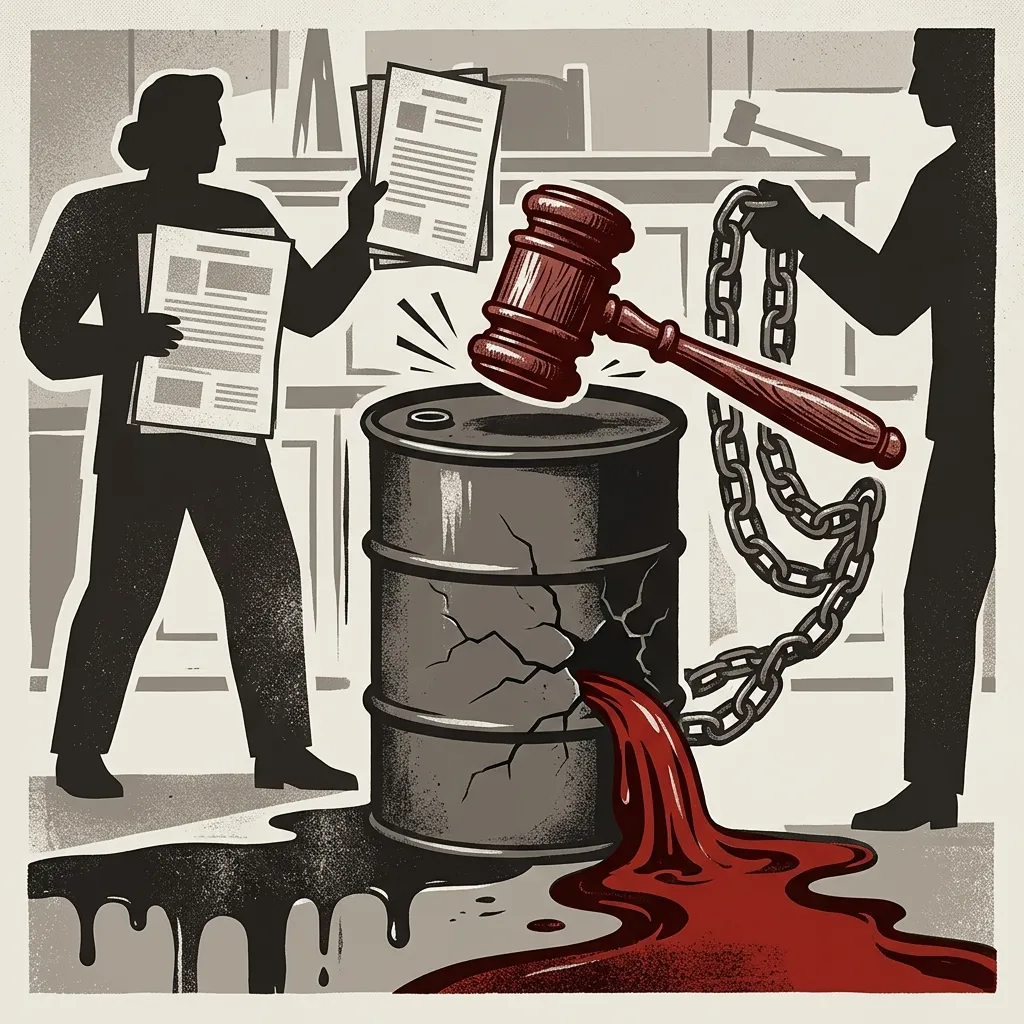
China has moved from verbal warnings to formal legal action against U.S. sanctions targeting its independent oil refineries, a development framed by one major source as a significant escalation in a long-simmering economic conflict. The Chinese Ministry of Commerce issued an injunction on May 2 to block U.S. restrictions imposed on five Chinese refineries for importing Iranian oil. This action signals a shift from years of quiet adaptation to a more structured confrontation over energy trade and unilateral sanctions, according to analysis from Russian state media. Concurrently, data from Latin America indicates a surge in oil production in Brazil, potentially reshaping global supply dynamics amid the tensions.
According to the report from RT, a Russian state-funded outlet, this Chinese decision is historically significant and marks a new phase in what it terms an 'oil war' with Washington. The source details a gradual escalation over the past year, beginning with the sanctioning of the Shouguang Luqing refinery in March 2025. By October, three other independent 'teapot' refineries faced U.S. restrictions. The tipping point, as framed by RT, came in April 2026 with sanctions against the Hengli Petrochemical refinery in Dalian, a facility described as having a capacity of 400,000 barrels per day, which exceeds the combined capacity of the four previously sanctioned plants. This sequence of events is presented as a calculated pressure campaign by the U.S. that finally provoked a decisive Chinese countermeasure.
The RT analysis provides specific context on China's legal preparations, noting that a local law designed to counter foreign sanctions was passed in 2021 but remained largely symbolic. The source attributes the delay to a thaw in U.S.-China relations during the Biden administration, suggesting the law was strategically put on hold. The directive to activate this law was reportedly only signed by Chinese Premier Li Qiang in March 2025, setting the stage for the recent injunction. This framing presents China's actions as a slow, deliberate, and legally grounded response to sustained external pressure, rather than a sudden or aggressive move.
In contrast, a report from the Argentine mainstream newspaper Clarín focuses on a different regional consequence of the underlying U.S.-Iran tensions. It highlights that Brazil reached a new record in oil production in March, surpassing 4 million barrels per day. This represents a 4.6% increase from February and a 17.3% rise compared to March 2025. The report identifies Petrobras, Shell, and TotalEnergies as the main producers driving this surge. While not directly analyzing the China-U.S. dispute, the data implies a significant reconfiguration of global oil supply chains, with major producers outside the conflict zone potentially benefiting from and filling gaps created by the sanctions regime on Iranian oil.
Framing the Conflict The two sources frame the geopolitical and economic landscape in distinctly different ways. RT's narrative is centered on a direct great-power confrontation, framing the issue as an 'oil war' where China is now openly pushing back against U.S. hegemony and unilateral sanctions. It emphasizes strategic patience, legal preparation, and a response triggered by a threshold event (the sanctioning of the large Dalian refinery). Clarín, conversely, sidesteps the narrative of direct confrontation. Its framing is economic and regional, focusing on how global market disruptions—implicitly linked to sanctions on Iran—create opportunities for other major producers like Brazil to increase output and market share. This perspective presents the situation less as a binary conflict and more as a complex market realignment with multiple winners and losers.
In synthesis, the reports illustrate a multifaceted global reaction to U.S. sanctions policy. One perspective details a formal, legalistic counter-escalation by a major power, China, challenging the enforcement mechanisms of U.S. foreign policy. The other highlights a pragmatic market response, where a major Latin American economy capitalizes on the resulting trade dislocations to boost its own production. Together, they suggest that pressure on one node of the global energy network (Iran) is creating ripple effects, provoking direct resistance from one economic heavyweight and creating lucrative openings for another, thereby testing the coherence and effectiveness of the sanctions regime itself.