
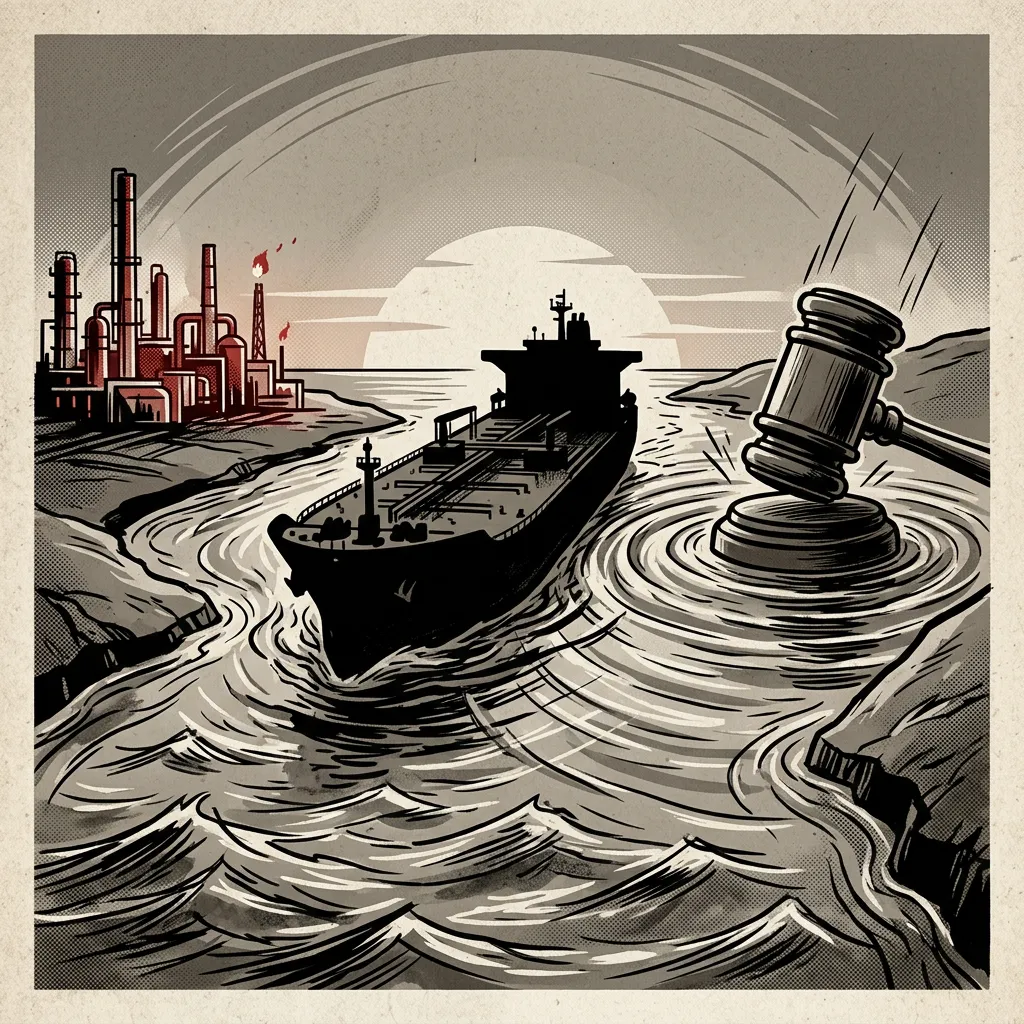
China has formally instructed its domestic companies to disregard US sanctions targeting refineries linked to Iranian oil, framing the American measures as illegal and a violation of its sovereignty. The move, announced by China's Ministry of Commerce, directly challenges a recent US Treasury warning to banks against dealing with certain Chinese 'teapot' refineries. This confrontation unfolds against a backdrop of parallel US pressure on global shipping firms, threatening sanctions if they pay tolls to Iran for passage through the Strait of Hormuz, a critical oil transit chokepoint.
Chinese and Russian Framing: Sovereignty and Illegitimacy Reporting from RT, a Russian state-affiliated outlet, presents China's directive as a firm assertion of national rights against unilateral US coercion. The article highlights Beijing's legal argument, noting that China views sanctions imposed without a United Nations mandate as illegitimate under international law. RT's coverage quotes the Chinese Commerce Ministry's statement that the US restrictions interfere with normal trade and must be ignored to protect China's 'national sovereignty, security and development interests.' The report also notes the official Chinese position that major state-owned firms deny direct purchases of Iranian crude, and that customs data shows no recorded imports since 2023—a point presented without further interrogation, aligning with the narrative of China operating within formal legal boundaries.
Indian Media's Focus on Diplomatic and Legal Wrangling Coverage from The Hindu, an Indian mainstream newspaper, provides a more measured, diplomatic lens. Its reporting on China's rejection of the sanctions zeroes in on the precise language of the Chinese statement, emphasizing the accusation that US actions 'violate international law and the basic norms governing international relations.' This framing presents the conflict as a clash over the rules-based international order. In a separate article, The Hindu details the US warning to shipping companies regarding Iranian tolls in the Strait of Hormuz, providing crucial context by stating that about one-fifth of the world's oil and gas trade passes through this waterway. This factual emphasis underscores the high economic stakes of the US pressure campaign and its potential to disrupt global energy flows.
Western Perspective: Sanctions as a Tool Amidst Broader Diplomacy The BBC's report, while brief in the provided excerpt, contextualizes the US sanctions threat within the wider, stalled diplomatic landscape between Washington and Tehran. By noting that the warning to shipping firms comes as former President Trump expressed being 'not excited' by an Iranian peace proposal, the BBC implies a connection between coercive economic measures and diplomatic posturing. This framing suggests the sanctions are not an isolated trade policy but part of a broader, often contentious, strategy to influence Iranian behavior, with China's defiance emerging as a significant complicating factor.
Framing the Conflict The sources diverge significantly in their narrative emphasis. RT and Chinese official statements construct a narrative of principled resistance: China is defending its sovereign right to trade and challenging illegal, hegemonic US overreach. The legal argument against 'unilateral' sanctions is central. The Hindu offers a more neutral, procedural account, focusing on the exchange of official statements and the tangible risks to global shipping, thereby framing the event as a significant international dispute with material consequences. The BBC snippet, meanwhile, embeds the action within the ongoing US-Iran adversarial relationship, framing the sanctions as one lever in a complex geopolitical struggle where China's role is that of a powerful spoiler.
Synthesis and Broader Implications The synthesis of these reports reveals a multi-layered confrontation. At its core is a direct economic clash between US secondary sanctions and Chinese commercial interests, elevated by Beijing to a matter of fundamental principle. The parallel US pressure on global shipping illustrates the administration's attempt to enforce a comprehensive financial blockade on Iran, a strategy that now faces its most formidable challenge from the world's largest oil importer. China's explicit order to its companies to ignore US dictates marks a significant escalation, moving beyond covert trade to open defiance. This not only threatens the efficacy of the US sanctions regime but also risks drawing other nations into choosing sides, potentially fragmenting the global financial and trading system along geopolitical fault lines. The stability of critical maritime passages like the Strait of Hormuz adds a layer of tangible risk to the escalating war of words and policies.