
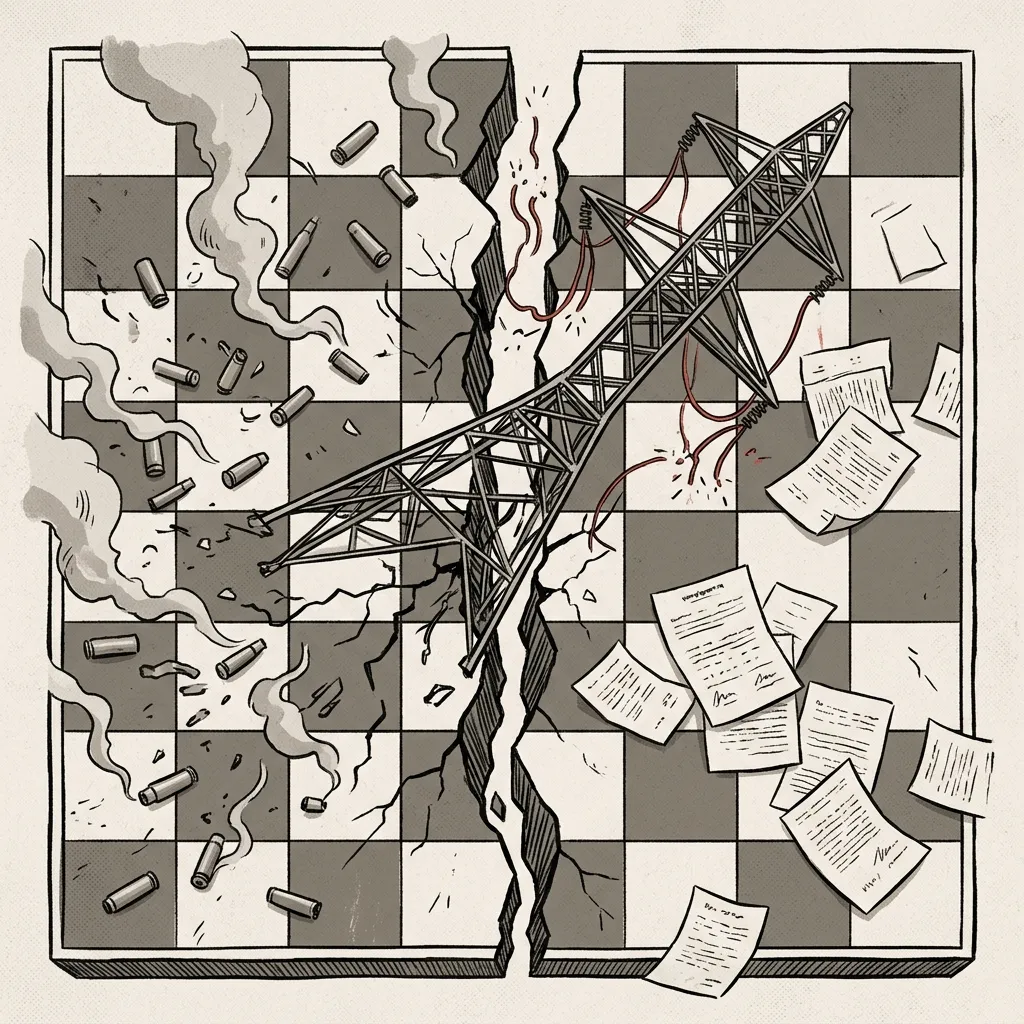
Recent days have seen a flurry of diplomatic and military activity in the Russia-Ukraine war, characterized by competing ceasefire proposals and a sharp escalation in long-range strikes on civilian and energy infrastructure. The developments highlight a stark contrast between high-level political gestures and the intensifying violence on the ground, with narratives diverging sharply along geopolitical lines.
Diplomatic Moves and Conflicting Claims A central diplomatic development involves a proposed temporary ceasefire around Russia's May 9 Victory Day. According to reports from the independent Russian outlet Meduza, the idea emerged from a phone call between Russian President Vladimir Putin and U.S. President Donald Trump. Kremlin aide Yuri Ushakov is cited stating the initiative came from Putin, with Trump offering active support. However, Trump himself later claimed it was his suggestion to urge a brief halt in fighting. The Kremlin's position, as articulated by spokesman Dmitry Peskov, is that the ceasefire is a unilateral decision by the Russian head of state that will be implemented regardless of whether Ukraine agrees. Peskov is quoted as saying the action "will be carried out," though he added that a response from the "Kyiv regime" indicating "appropriate intentions" was expected but not received.
Ukrainian President Volodymyr Zelenskyy's response, covered by Meduza and the Indian newspaper The Hindu, frames the proposal cautiously. Zelenskyy stated he was seeking more details from the United States to understand if the offer meant "a few hours of safety for a parade in Moscow or something more substantial." He emphasized Ukraine's goal is a long-term ceasefire and lasting peace, not a brief pause for a Russian military parade. This positions Ukraine as seeking substantive security guarantees rather than a symbolic gesture.
Military Escalation Amidst Talk of Pauses Simultaneously, reporting details a significant intensification of strikes deep behind front lines. One Meduza report states that Russian forces launched a major drone attack on the city of Odesa, injuring at least 20 people and damaging residential buildings, a kindergarten, a hotel, and other civilian infrastructure. The report cites local Ukrainian officials providing casualty figures and damage assessments, noting that Ukrainian air defenses claimed to have intercepted 172 of more than 200 drones launched. In a parallel development, another Meduza article details Ukrainian drone strikes targeting an oil pipeline station in Perm, Russia, for a second consecutive day. The report, which cites local Telegram channels and residents, describes explosions, evacuations, school closures, and an "oil rain" effect from the previous day's attack. It notes that pro-war Russian Telegram channels acknowledged the strikes were carried out by Ukrainian drones now capable of reaching distances up to 2,000 kilometers.
A Prisoner Exchange and its Framing A separate narrative involves a prisoner exchange. Meduza summarizes an interview given by a Russian archaeologist, Aleksandr Butyagin, to the state outlet RT after his release from detention in Poland. Butyagin, who was held at Ukraine's request over archaeological work in Crimea, expressed gratitude that his "country came to my aid." The Meduza report presents his reflections on the politicization of science, quoting him as saying "the illusion that science exists outside of politics has been shattered." This story is framed as an individual account of geopolitical entanglement, distinct from state-level diplomatic or military reports.
Framing the Conflict The sources present fundamentally different narratives about responsibility and intent. The Kremlin's framing, as reported by Meduza, presents the ceasefire as a sovereign, unilateral act of Russian will, downplaying any need for Ukrainian consent and characterizing the Kyiv government as an unresponsive "regime." This contrasts sharply with the Ukrainian perspective, which seeks to reframe the discussion from a short-term Russian ceremonial pause to a negotiation about long-term security. The military reports further illustrate this divide: the attack on Odesa is presented in terms of civilian casualties and damage to non-military targets, while the strike on Perm is described in the context of targeting energy infrastructure and its logistical impact, with Ukrainian channels claiming the target and Russian channels acknowledging the drones' extended range.
Broader Geopolitical Context The diplomatic friction extends beyond the immediate battlefield. The Russian state-affiliated outlet RT reports on U.S. President Donald Trump criticizing German Chancellor Friedrich Merz, suggesting he should focus on ending the Ukraine conflict and fixing domestic issues rather than questioning U.S. strategy regarding Iran. This report frames Western allies as divided and ineffective, with Trump quoted saying the chancellor has been "totally ineffective" on Ukraine. It also reiterates the Russian position that Western arms deliveries to Ukraine only "unnecessarily prolong the hostilities." This external commentary reinforces a narrative of Western disunity and the futility of supporting Ukraine, which stands in direct opposition to the framing from Ukrainian and independent sources that emphasize the need for sustained defense and substantive peace talks.
The concurrent events—high-level ceasefire discussions, a prisoner swap framed as a national rescue, and severe reciprocal strikes—paint a picture of a conflict operating on multiple, disconnected levels. The diplomatic gestures appear disconnected from the military reality of escalating attacks on civilian areas and critical infrastructure, suggesting that any temporary pause may do little to alter the fundamental dynamics of a war where both sides are demonstrating an increased capacity to strike deep into each other's territory.