
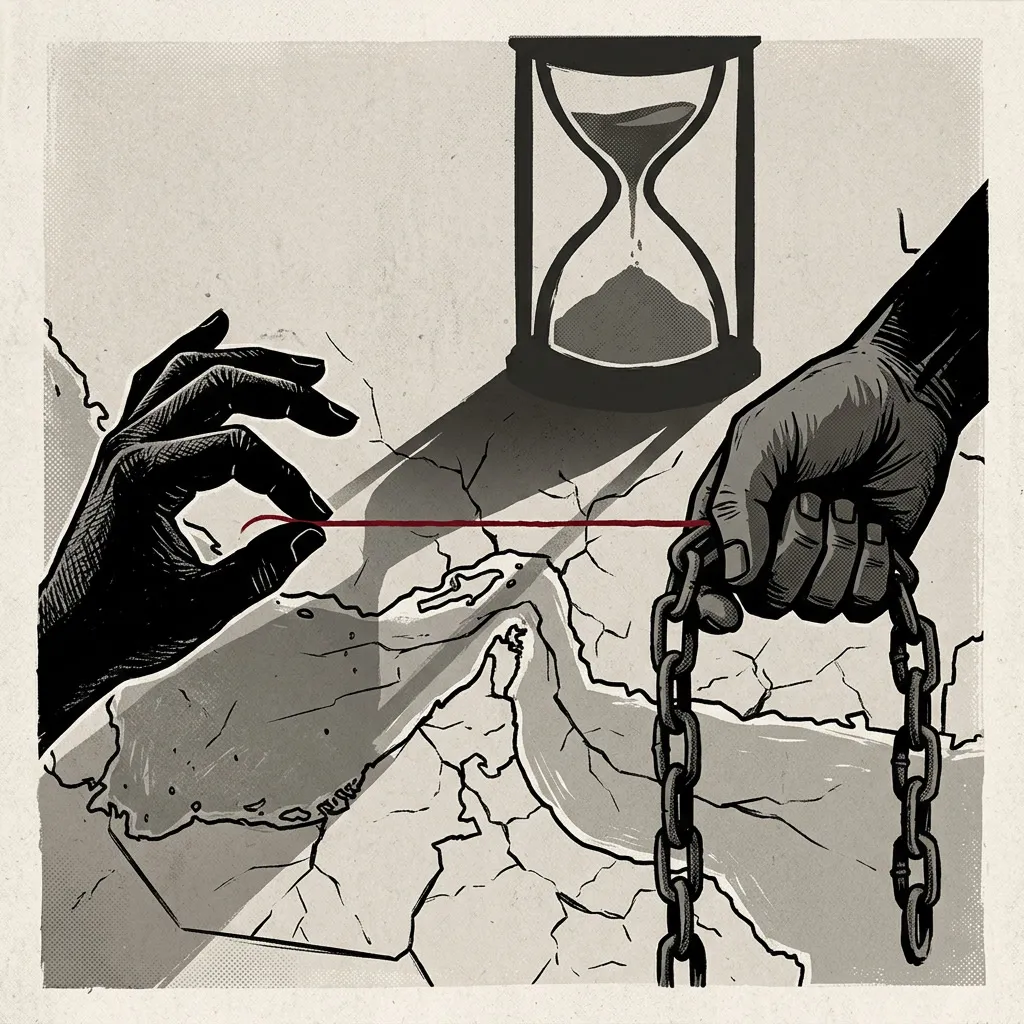
A fragile ceasefire between the United States and Iran, in place for over three weeks, is holding but under significant strain from domestic political deadlines, economic warfare, and diverging public claims from both sides. The Trump administration has declared its military actions 'terminated' ahead of a 60-day congressional deadline, while Iranian leadership describes the ongoing U.S. naval blockade as 'intolerable.' The situation is defined by a U.S. strategy of economic pressure through a blockade of the Strait of Hormuz, internal U.S. debates over war powers, and starkly different assessments of how quickly this pressure will force Iranian capitulation.
U.S. Administration's Legal and Strategic Position U.S. Defense Secretary Pete Hegseth testified before Congress that the ongoing ceasefire suspends the legal requirement for the Trump administration to seek congressional authorization to continue the war, a point reported by both Latin American and Indian outlets. An official from the administration stated that hostilities have been 'terminated' for the purposes of the War Powers Act deadline, as covered by The Hindu, which notes there has been no exchange of fire since the truce began. The administration's public strategy, detailed in Politico Europe's analysis, centers on a naval blockade designed to trigger an imminent energy crisis in Iran. Senior officials, including Treasury Secretary Scott Bessent, claim Iran is merely 'days' away from exhausting its oil storage capacity, which they argue will force production shutdowns and inflict permanent damage on Iran's oil infrastructure, yielding an estimated $500 million in daily lost revenue.
Iranian Response and Counter-Narratives Iranian officials have publicly mocked the U.S. predictions. Parliament Speaker Mohammad Bagher Ghalibaf, cited in Politico Europe's report, challenged the U.S. narrative directly on social media, stating that oil wells were not at risk of explosion and suggesting the U.S. was receiving 'junk advice.' The Iranian president has condemned the U.S. siege as 'intolerable,' a framing prominently featured in Al Jazeera's coverage. Beyond rhetoric, reports from RT indicate the conflict may be escalating militarily in other ways, with U.S. Central Command reportedly requesting the deployment of untested Dark Eagle hypersonic missiles to the region, allegedly because Iran has moved its ballistic missile launchers out of range of existing U.S. systems.
Expert Analysis and Economic Realities Energy experts and analysts present a significantly more protracted timeline for Iran's economic distress than the U.S. administration. Reports from Politico Europe and Clarin synthesize expert views suggesting Iran has between three to six weeks of storage capacity remaining, not days. Analysts like Robin Mills of Qamar Energy argue that Iran has a high tolerance for economic pain and a history of managing production shutdowns without catastrophic damage. The blockade's primary impact, according to a Kpler analyst cited by Politico, would only severely curtail Iran's oil revenues three to four months into the future. Meanwhile, the global economic fallout is immediate. Al Jazeera reports U.S. gasoline prices have surged to $4.30 per gallon, a jump of nearly 30 cents in a week, which Politico notes is fueling domestic political pressure on the Trump administration from both Democrats and concerned Republican groups.
Framing the Conflict The framing of the conflict varies notably by region. U.S. and European-focused outlets like Politico Europe present the story through the lens of U.S. domestic policy, war powers, and the global oil market, balancing administration claims with skeptical expert analysis. Middle Eastern sources, particularly Al Jazeera, emphasize the humanitarian and regional impact, labeling the U.S. actions a 'siege' and highlighting the 'intolerable' pressure on Iran, while also noting collateral conflicts such as Israeli attacks in Lebanon. Latin American reports from Folha and Clarin focus on the legal mechanics of the U.S. war powers debate and the technical details of the oil blockade's stranglehold. Indian reporting from The Hindu adopts a more neutral, fact-based tone, centering on the official declarations regarding the ceasefire and legal deadlines. Russian outlet RT introduces a narrative of potential U.S. military escalation and technological vulnerability with its report on hypersonic missile requests.
In conclusion, the ceasefire represents a tactical pause rather than a diplomatic resolution. The U.S. is leveraging the time to argue it has met legal obligations and to intensify economic pressure, betting on a swift Iranian collapse. Iran is publicly resisting this narrative, attempting to portray U.S. strategy as misguided and highlighting the global economic costs. The divergent expert assessments on the timeline of Iran's economic pain suggest the conflict is entering a war of attrition, where domestic political pressures in the U.S., fueled by rising energy prices, may prove as consequential as the military and economic pressure on Tehran.