
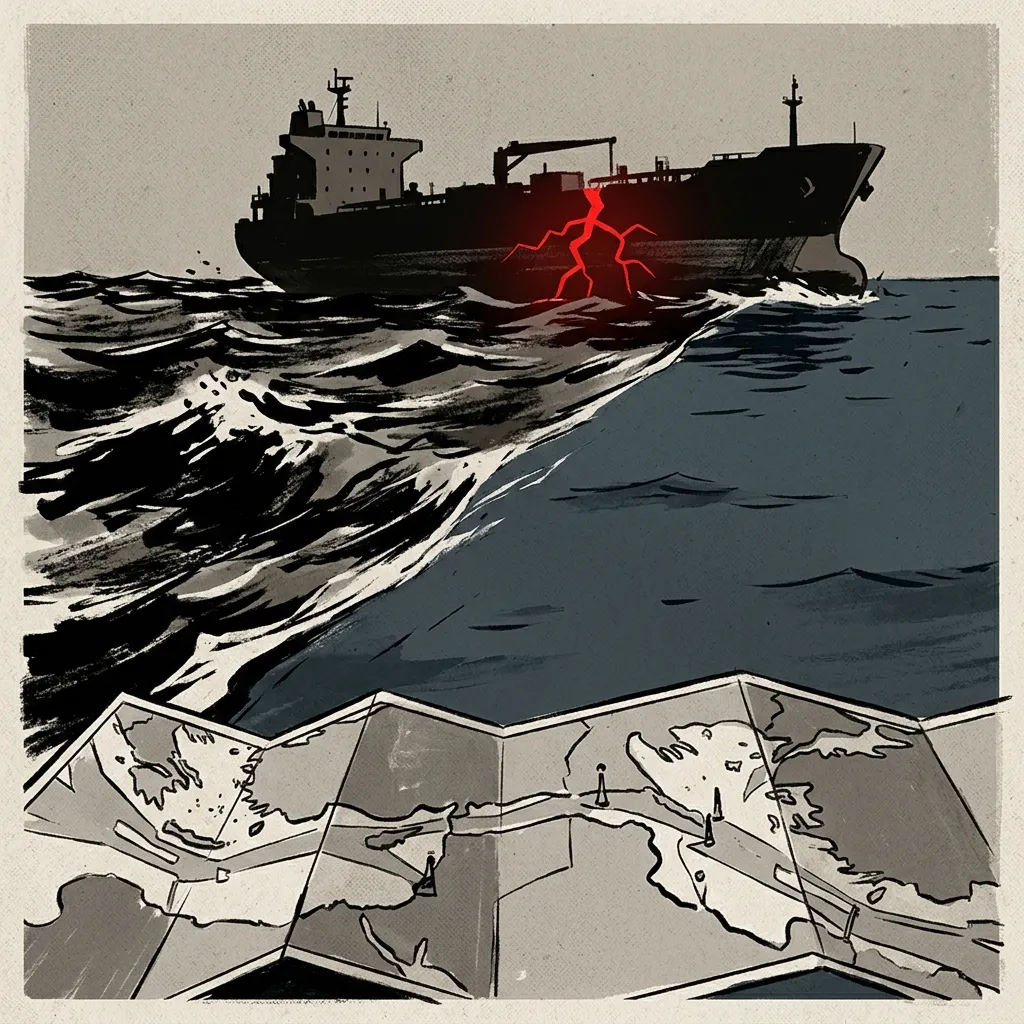
Two commercial vessels were targeted in separate incidents near the Strait of Hormuz on Sunday, according to maritime security reports. The attacks on a bulk carrier and a tanker in the vicinity of one of the world's most critical oil transit chokepoints have raised immediate security concerns, with regional and international sources offering differing contextual frames for the events.
According to the United Kingdom Maritime Trade Operations (UKMTO), the first incident involved a northbound bulk carrier approximately 11 nautical miles west of Sirik, Iran. The agency reported the vessel was attacked by multiple small craft. The crew was confirmed safe, and no environmental damage was reported. Hours later, a second alert concerned a tanker struck by unidentified projectiles about 78 nautical miles north of Fujairah in the United Arab Emirates.
RT's reporting places these incidents within a specific geopolitical context. The Russian outlet immediately notes that the strategic waterway is under what it terms a 'dual blockade.' It states that Iran is restricting access to what it calls 'hostile vessels,' while U.S. naval forces are simultaneously blocking ships from entering or leaving Iranian ports. This framing presents a scenario of mutual, escalating military postures, implicitly suggesting the attacks occur within an environment of reciprocal hostility. RT's article is also directly paired with promotional content for a related report on an 'Iran peace proposal' that includes a 'new mechanism to govern the Strait of Hormuz,' linking the news event to a specific diplomatic narrative favored by Tehran.
Al Jazeera's coverage, in contrast, focuses more narrowly on the operational details and immediate regional reactions. The Qatari-based network's report centers on the bulk carrier attack off Iran's coast, providing the safety confirmation and lack of environmental impact. It incorporates statements from the Iranian navy, which claimed to have dispatched vessels to assist the ship after receiving a distress call. Al Jazeera also provides significant background, detailing a recent 'tit-for-tat' series of ship seizures between Iran and the United States, and notes the U.S. Fifth Fleet's presence in the region. This framing acknowledges the tense history but presents it as a sequence of actions and reactions, without explicitly characterizing the current state as a 'blockade.'
Framing the Conflict The core factual reporting from the UKMTO is consistent across sources: two attacks, locations, and vessel types. The primary divergence lies in the explanatory context woven around these facts. RT constructs a narrative of a waterway actively and equally partitioned by two adversarial powers, Iran and the United States. The attacks are presented as occurring within this fraught, symmetrical standoff. Al Jazeera, while also detailing U.S.-Iran tensions, frames the incident more as a discrete security event within an ongoing cycle of regional friction. It highlights the Iranian navy's response as a provider of aid, potentially shaping perception of Iran's role in the incident's aftermath. RT's narrative leans toward explaining why the environment is volatile (a dual blockade), while Al Jazeera's details what has happened recently to make it volatile (a history of seizures).
The implications of these differing frames are significant for understanding regional narratives. One presentation may lead audiences to view the Strait as a space of contested control between two roughly equivalent forces, potentially normalizing the Iranian restrictions as a counterpart to U.S. actions. The other presentation keeps the focus on the attack as a destabilizing event within a known conflict, emphasizing the operational military responses and the immediate threat to shipping. Both, however, underscore the extreme fragility of security in a passage vital to global energy supplies, where any incident risks rapid escalation.