
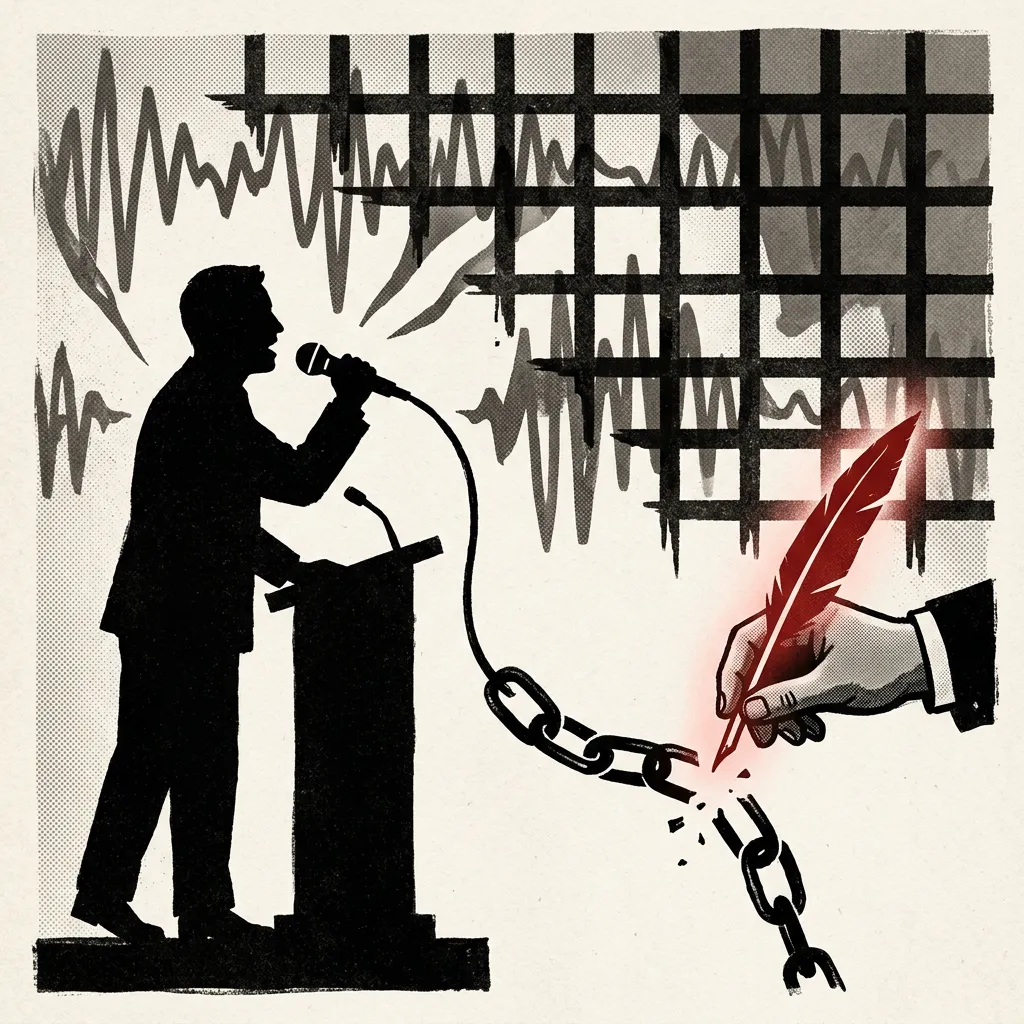
The American Broadcasting Company (ABC) has formally petitioned the U.S. Federal Communications Commission, arguing that the agency's recent efforts to apply 'equal time' rules to political interviews on talk shows constitute an unprecedented threat to free speech and editorial discretion. The dispute centers on FCC Chair Brendan Carr's interpretation of long-standing regulations, which ABC claims creates legal uncertainty and could stifle political coverage ahead of the 2026 midterm elections. This confrontation highlights a significant tension between broadcast regulation and constitutional protections in a politically charged environment.
According to Politico Europe, ABC, owned by Disney, submitted a 52-page regulatory filing that strongly criticizes the FCC's actions. The network warns that Chair Carr's approach to wielding a decades-old 'equal time' rule against programs like ABC's 'The View' threatens to 'chill' core First Amendment-protected speech. The report notes that such talk shows had historically relied on an FCC exemption for 'bona fide' news interviews, but that exemption is now in doubt due to Carr's guidance issued in January. This guidance suggested that daytime and late-night shows should not automatically presume they are exempt from equal time requirements when hosting political candidates. ABC's petition requests that the FCC honor the news exemption for 'The View' and provide greater certainty to broadcasters, especially with an election cycle approaching. The Politico report frames this as the latest in a series of confrontations between broadcasting networks and Carr, whom it describes as using his tenure to wage fights against perceived foes of former President Donald Trump. It also connects the filing to a broader conflict between Disney and the FCC, citing a separate investigation into the company's diversity practices.
The FCC's perspective, as presented in the Politico article through an anonymous spokesperson, defends Carr's actions as enforcing a law passed by Congress. The spokesperson states that the law is designed to prevent broadcast programs from favoring one political candidate over another and to ensure that both Republican and Democrat candidates receive equal time on public airwaves. The FCC argues this law encourages more speech and empowers voters. The article also notes that the FCC's lone Democratic commissioner, Anna Gomez, publicly supported Disney's pushback, suggesting internal division within the agency.
Folha de S.Paulo's coverage, originating from Latin America, presents the conflict with a distinct geopolitical framing. The Brazilian outlet's headline directly accuses the 'Trump government' of violating freedom of expression, explicitly linking the FCC's regulatory actions to the former president's administration. This framing presents the dispute not merely as a regulatory or legal debate between a broadcaster and an independent agency, but as a political clash between a media company and the governing power. While Politico Europe details the legal arguments concerning the 'equal time' rule and the 'bona fide news' exemption, Folha's summary emphasizes the potential for a 'prolonged judicial dispute' between ABC and the Trump government, casting it as a high-stakes battle over fundamental rights.
Framing the Regulatory Conflict The synthesis of these reports reveals clear differences in how the core event is contextualized. Politico Europe provides a detailed, process-oriented account focused on the regulatory mechanics of the FCC's 'equal time' rule, the specific exemption for news interviews, and the potential impact on broadcast journalism. It situates the event within a pattern of actions by FCC Chair Carr and a broader conflict with the Disney corporation. In contrast, Folha de S.Paulo employs a more politically charged narrative, immediately defining the event as an accusation against the 'Trump government.' This framing bypasses the nuances of the FCC's nominal independence and presents the conflict in a simpler, more adversarial light: media versus the state. The European source delves into the legal uncertainty and its chilling effect on speech, while the Latin American source highlights the confrontation as a potential landmark struggle for press freedom against a specific administration.
In conclusion, the ABC petition against the FCC represents a significant flashpoint in the ongoing debate over media regulation, political neutrality, and free speech protections in the United States. The divergent regional framings underscore how the same bureaucratic and legal dispute can be interpreted either as a complex regulatory challenge with implications for editorial practice or as a direct political assault on fundamental liberties by a specific administration. The outcome of this confrontation could set important precedents for how broadcasters cover elections and interact with regulatory bodies, with potential ramifications extending far beyond the specific case of 'The View.' The support from within the FCC by Commissioner Gomez indicates the controversy is not merely external but reflects deep internal divisions on the commission's role and reach.