
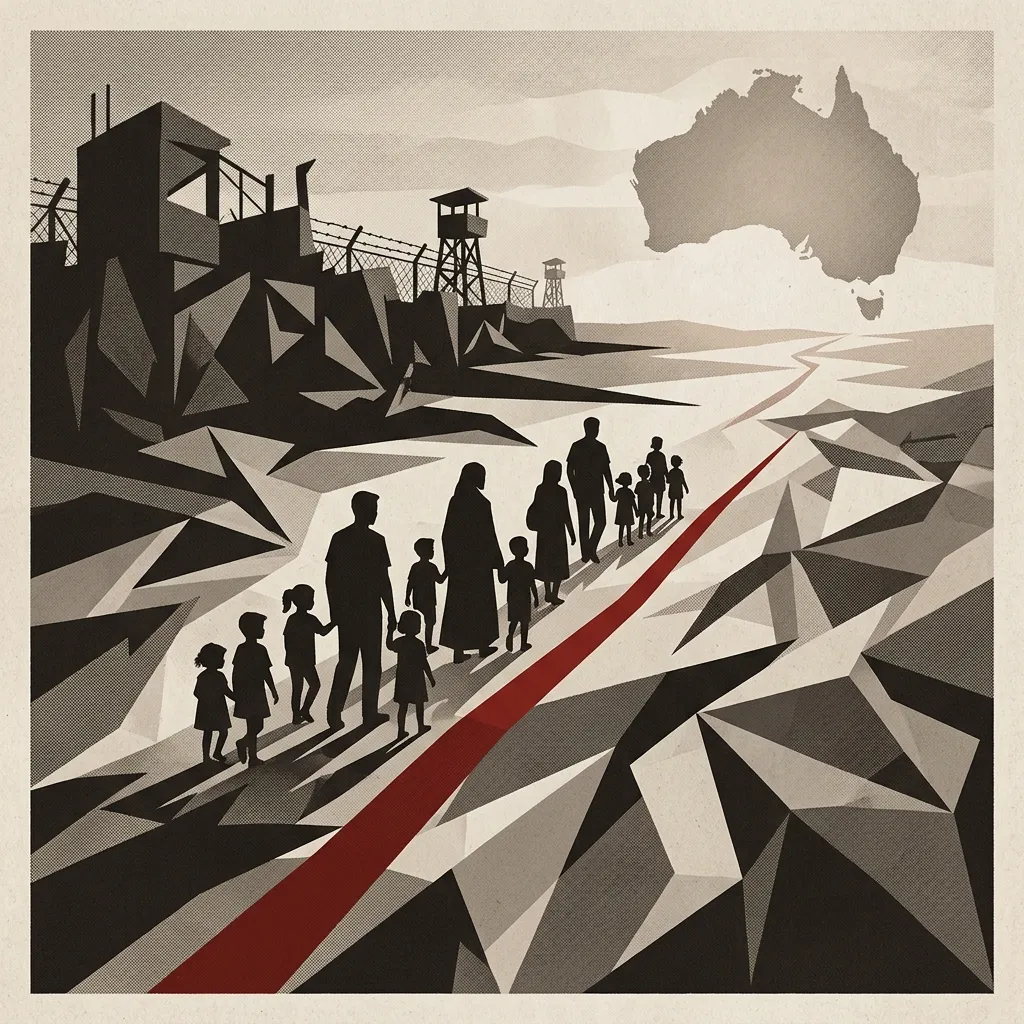
The Australian government has confirmed that 13 of its citizens, comprising four women and nine children with alleged links to Islamic State (IS), are scheduled to return from Syria. The group, which has spent years in a detention camp, has secured travel arrangements to come back to Australia. The announcement has sparked a national discussion on security protocols, citizenship rights, and the government's duty of care, with official statements emphasizing a risk-managed approach to repatriation.
Channel News Asia's reporting frames the development primarily as a national security and immigration management issue for the Australian government. The coverage focuses on the official confirmation and the logistical aspects of the return, highlighting the government's stance that these individuals pose a potential threat. The narrative underscores the challenges of balancing security concerns with legal and humanitarian obligations, placing the event within the context of Australia's ongoing counter-terrorism policies. The report adopts a matter-of-fact tone, typical of mainstream Asian news outlets, presenting the information as a statement of administrative action with regional security implications.
In contrast, BBC News employs a more narrative-driven and human-centric framing. While also reporting the government's security concerns, the BBC's headline and content immediately personalize the story by specifying 'four women and nine children' and noting they 'have spent years in a Syrian camp.' This language implicitly introduces elements of a humanitarian situation alongside the security narrative. The BBC's coverage tends to contextualize the event within broader international debates about the fate of families associated with extremist groups in conflict zones, suggesting a story about complex repatriation dilemmas faced by multiple Western nations.
Framing the Repatriation The core divergence between the sources lies in their central narrative focus. Channel News Asia presents a top-down, state-centric view where the primary actor is the Australian government managing a security problem. The individuals returning are framed collectively as 'citizens linked to alleged IS members,' a formulation that maintains a degree of legal distance and emphasizes their alleged association. The BBC, however, constructs a more granular picture, immediately identifying the demographic breakdown of the group and their prolonged detention. This framing invites consideration of their circumstances as detainees and potentially as victims, without diminishing the reported security risks. The BBC's approach aligns with a common Western media lens that scrutinizes state action concerning citizens in overseas detention, whereas Channel News Asia's reporting reflects a regional perspective often more attuned to interstate security ramifications.
Both sources agree on the basic facts: the number of individuals, their composition, their alleged links to IS, and their impending return under government oversight. Neither source provides contradictory factual claims. However, their emphasis diverges significantly. The Asian source prioritizes the official announcement and the policy implications, keeping the story firmly within the realm of government action. The European source builds a narrative that, while reporting the same official line, uses descriptive details to humanize the subjects and subtly frame the event as part of a wider, morally complex international issue. This difference shapes how audiences might perceive the story—as either a straightforward security update or a layered saga involving governance, security, and human rights.
In conclusion, the repatriation of these 13 Australians highlights the enduring global challenge of dealing with citizens connected to foreign terrorist organizations. The reporting underscores a universal tension between national security imperatives and obligations to citizens, but the framing varies by regional editorial perspective. The event serves as a case study in how different media ecosystems prioritize angles: one focusing on state policy and regional stability, and the other on the human dimensions of a protracted geopolitical dilemma. The synthesis of these reports reveals not a dispute over facts, but a difference in the narrative aperture through which a single governmental action is viewed and contextualized for audiences in Asia and Europe.