
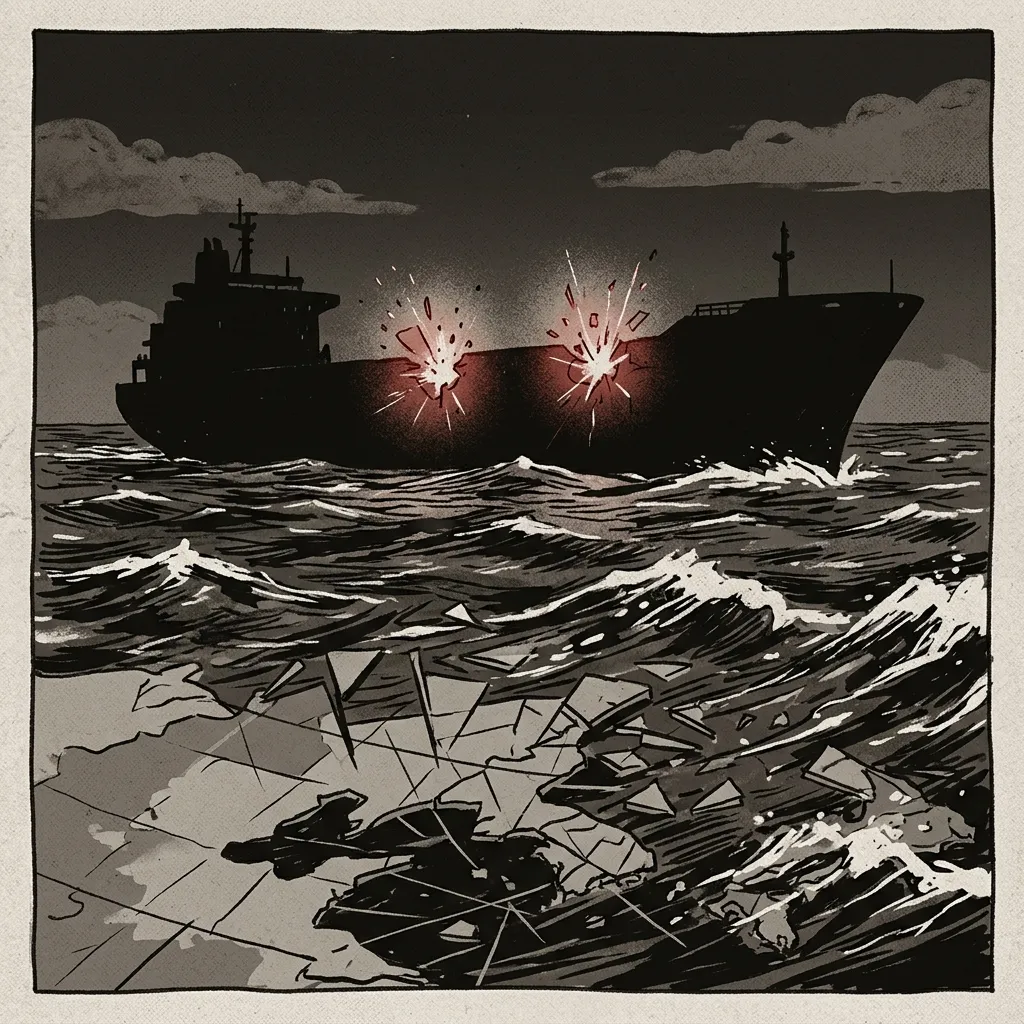
Two separate attacks on commercial vessels near the strategic Strait of Hormuz have been reported by maritime authorities, underscoring persistent instability in a critical global energy corridor. The incidents, involving a bulk carrier and a tanker, occurred hours apart off the coasts of Iran and the United Arab Emirates. The reports emerge amid a backdrop of stalled diplomatic negotiations and heightened military posturing in the region, with different news outlets framing the events through distinct geopolitical lenses.
Source Perspectives
RT (Russia) provides the most detailed contextual framing of the incidents. It immediately situates the attacks within what it describes as a "dual blockade" of the strategic waterway. The report states that Iran is restricting access to vessels it deems "hostile," while U.S. naval forces are simultaneously blocking ships from entering or leaving Iranian ports. This framing presents a scenario of mutual and equivalent responsibility for the heightened tensions. RT's coverage is also notable for its inclusion of promotional material for an Iranian peace proposal that suggests a "new mechanism to govern" the strait, directly linking the news event to a specific diplomatic initiative from Tehran.
Al Jazeera (Middle East) focuses its reporting more narrowly on the operational details and immediate consequences of the first attack on the bulk carrier. Its headline and lead emphasize the location "off Iran" and specifies that the vessel was attacked by "multiple small craft." The report confirms the crew's safety and notes no environmental damage, presenting a factual account of the incident's outcome. While it provides less of the broader geopolitical context offered by RT, its framing centers on the event itself and its direct impact, typical of initial wire-service style reporting.
The Hindu (India) offers a concise report centered on the second incident involving the tanker. Its headline highlights that the vessel was hit by "'unknown projectiles' off UAE coast," attributing the information to the U.K. maritime agency. Crucially, The Hindu provides a specific diplomatic context absent from the other summaries, explicitly linking the incident to the deadlock in U.S.-Iran peace negotiations following a ceasefire in the "West Asian war" that took effect on April 8. This framing directly connects the maritime insecurity to the stalled political process.
Framing the Conflict
The divergences in reporting reveal how the same events are contextualized within different regional and political narratives. RT's narrative emphasizes a standoff between two powers, Iran and the United States, portraying the strait as jointly blockaded. This framing avoids attributing blame for the attacks and instead highlights a generalized state of conflict, while also platforming an Iranian-proposed solution. Al Jazeera’s report is more geographically specific and incident-focused, providing neutral details on safety and location without venturing into broader blame or causation. The Hindu’s brief report offers a key piece of temporal and diplomatic context, situating the violence as a symptom of failed negotiations between Washington and Tehran, thus implying a direct link between diplomatic stagnation and regional security deterioration.
Synthesis and Implications
Collectively, the reports confirm a continuation of maritime threats in one of the world's most vital shipping lanes, with crews safe but commercial traffic facing significant risk. The variation in framing—from RT's emphasis on a bilateral military confrontation, to Al Jazeera's incident-specific facts, to The Hindu's focus on diplomatic breakdown—illustrates how regional media interpret events through the prism of local geopolitical concerns and alliances. The attacks serve as a tangible manifestation of the unresolved tensions in the region, whether framed as a product of mutual blockades, generic insecurity, or a failing peace process. The consistent thread is the vulnerability of global energy and trade flows to regional conflicts, with each source providing a different explanatory lens for why these waters remain dangerous.