
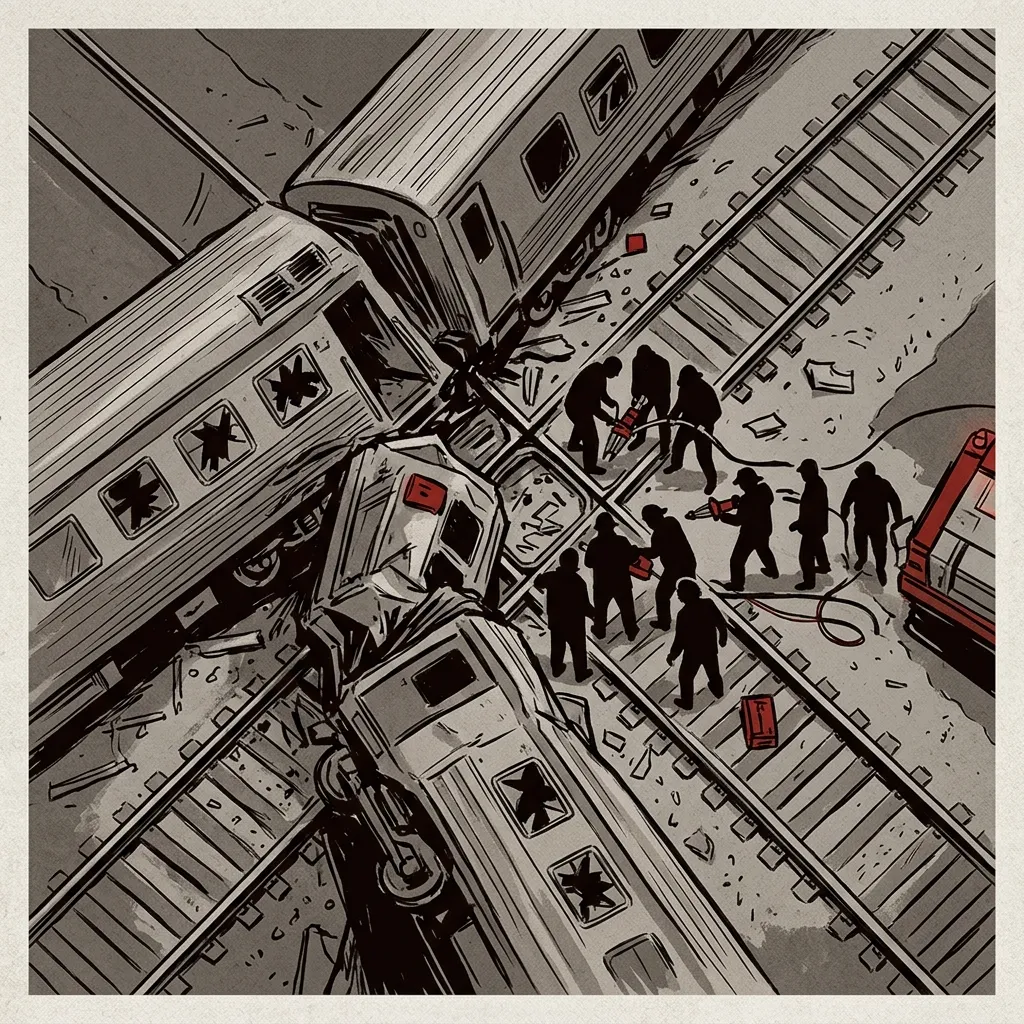
A collision involving two trains on the outskirts of Jakarta, Indonesia, has resulted in at least 14 fatalities, with rescue operations ongoing to extract passengers still trapped in the wreckage.
The incident occurred in Bekasi, near the Indonesian capital, on Monday. According to Bobby Rasyidin, Chief Executive of state-owned railway operator PT KAI, the sequence of events involved a taxi that had entered the train tracks and was struck by a commuter train. Subsequently, a long-distance train collided with a women-only carriage of the commuter train.
The death toll has evolved across reporting timelines. Initial reports indicated four or five fatalities, but this figure rose to 14 as rescue teams worked through the wreckage. The head of Indonesia's national rescue agency confirmed that efforts to remove trapped passengers from the damaged carriages remain active.
Multiple sources report that dozens of people sustained injuries in addition to the confirmed deaths. Rescue workers have been racing against time to free survivors still trapped inside the mangled train cars.
Reporting Variations
The sources present consistent core facts regarding the death toll and location, but differ in their emphasis and detail level. European coverage from BBC News frames the story primarily around the rescue effort, highlighting that responders are "racing to free survivors" while providing minimal detail about the collision's mechanics. The headline emphasizes the ongoing emergency response rather than the cause.
Indian outlet The Hindu provides the most specific explanation of how the crash unfolded, directly quoting the railway executive's account of the taxi on the tracks and the subsequent chain reaction. This source offers readers a clearer understanding of the collision sequence, presenting the railway official's statement as the authoritative explanation.
Middle Eastern coverage from Al Jazeera published multiple updates as the death toll climbed. Earlier reporting cited four deaths, while later updates confirmed 14 fatalities. Al Jazeera's framing emphasizes the evolving nature of the casualty count and the continuation of rescue operations, with one headline specifically noting that "efforts continue" to remove trapped individuals.
None of the sources provide information about potential causes beyond the immediate sequence of events—specifically, how or why a taxi came to be on the train tracks. No source attributes blame or discusses safety protocols, infrastructure conditions, or regulatory oversight. The reporting remains focused on the immediate emergency response and casualty figures.
The mention of a "women-only carriage" appears only in The Hindu's reporting, citing the railway executive. This detail, significant for understanding which train car sustained the impact, does not appear in the European or Middle Eastern coverage reviewed.
All sources agree on the basic geography—the crash occurred near Jakarta in the Bekasi area—and on the involvement of two trains. The state ownership of the railway operator is mentioned only in The Hindu's coverage, which may reflect different editorial priorities regarding corporate and governmental responsibility in infrastructure incidents.