
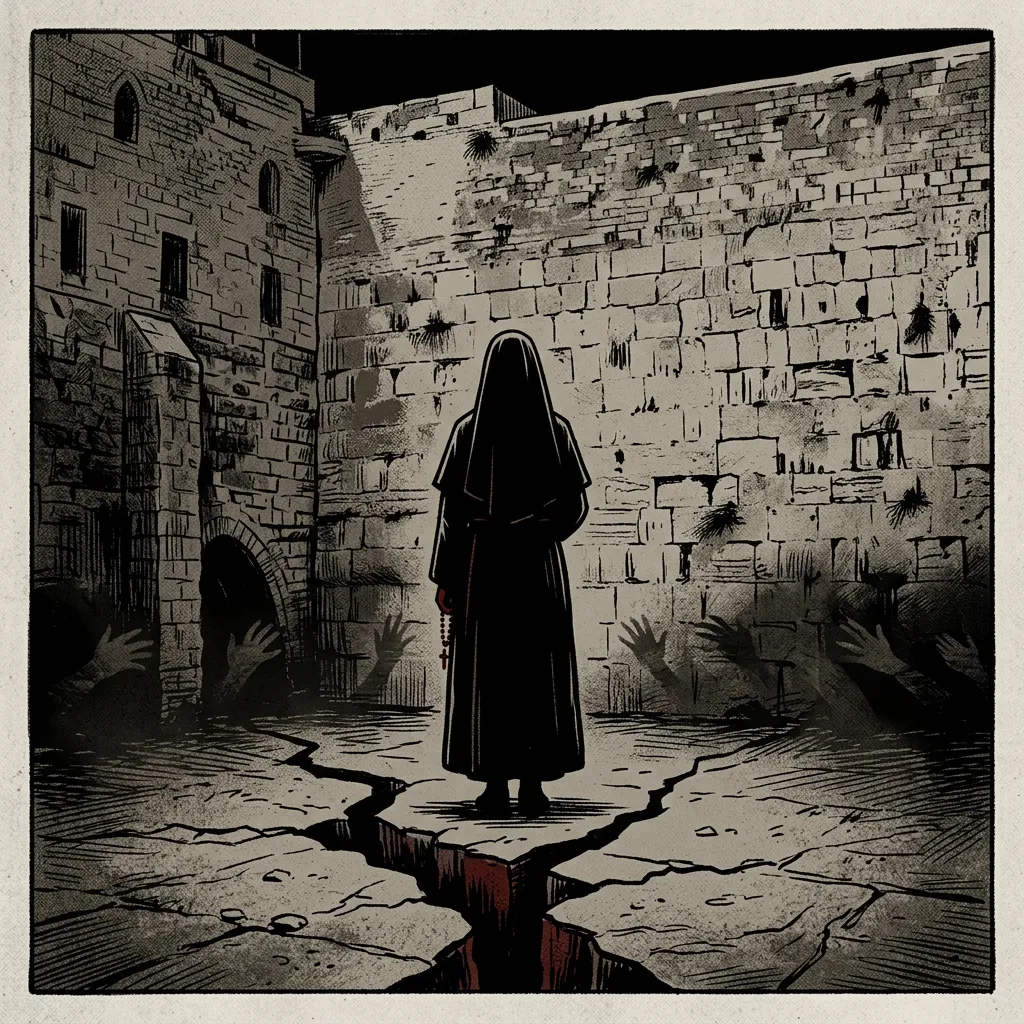
Israeli police have arrested a 36-year-old man suspected of a violent assault on a French Catholic nun near Jerusalem's Old City. The incident, captured on video, has drawn international attention and comes amid reported increases in harassment targeting Christian clergy and pilgrims in the city. Reports from Indian and Latin American outlets detail the arrest and the attack's circumstances while framing the event within differing regional concerns, from law enforcement categorization to broader sectarian tensions.
The Hindu, reporting from India, provides a concise account focused on the official police response. It notes the arrest was made "on suspicion of a racially motivated attack" and that the suspect remains in custody. The report is factual, emphasizing the legal categorization of the incident by authorities without extensive commentary on the victim's identity or the attack's visual details. Its framing is procedural, centering on the state's law enforcement actions and the initial charge.
In contrast, Folha de S.Paulo from Brazil offers a more descriptive narrative, reconstructing the event from released video footage. It details the sequence: the nun was walking when a man ran up behind her, pushed her to the ground, and then returned to kick her while she was down. This focus on the violent mechanics of the assault personalizes the victim as a "French Catholic nun" and underscores the brutality of the act. The report serves the facts but does so with a narrative emphasis on the attack's visceral nature.
Clarín, another major Latin American publication based in Argentina, introduces additional contextual framing not explicitly highlighted in the other reports. While confirming the arrest of the 36-year-old, it immediately links the event to a wider pattern, stating there are warnings about "an increase in incidents of harassment and violence against pilgrims and Christian clergy." Significantly, Clarín's headline identifies the assailant as an "ultra-Orthodox man," a detail about the suspect's perceived religious community that is absent from the other sourced reports. This framing places the individual act within a specific socioreligious context and a trend of inter-communal friction.
Framing the Conflict The divergence in reporting lies in the scope of context provided and the chosen emphasis. The Hindu presents a contained police bulletin, treating it as a discrete criminal matter under investigation. Folha de S.Paulo focuses on the act itself, using descriptive language to convey its severity. Clarín adopts the widest lens, explicitly connecting the attack to both the suspect's background (ultra-Orthodox) and a reported surge in anti-Christian sentiment. This creates a spectrum from a specific incident report to a symptom of broader sectarian tensions in Jerusalem.
In conclusion, the synthesis of these reports reveals an event processed through distinct editorial lenses. The core facts—an arrest following a violent attack on a religious figure—are consistent. However, the implications drawn vary from a matter of criminal justice to a concerning data point in a pattern of religiously motivated harassment. This reflects how regional media audiences might receive the news: either as a resolved police action, a shocking act of violence, or evidence of deteriorating interfaith relations in a contested holy city.