
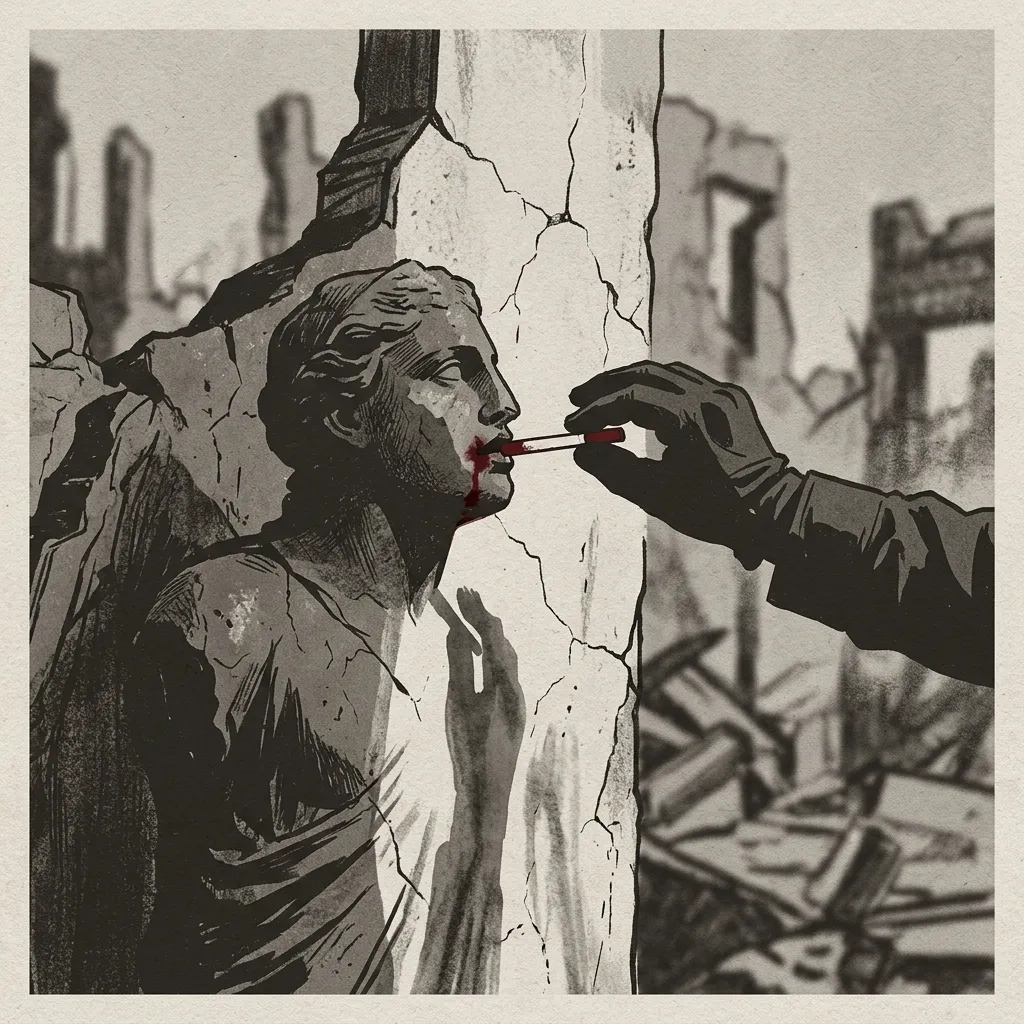
A photograph depicting an Israeli soldier interacting with a statue of the Virgin Mary in southern Lebanon has prompted an official military investigation and widespread condemnation. The image, which shows the soldier placing a cigarette into the statue's mouth, was reportedly taken in the village of Dibil. While sources agree on the core event, their reporting reveals significant differences in framing, historical context, and the implied significance of the act.
Al Jazeera's Reporting The Qatar-based network Al Jazeera, reporting from a Middle Eastern perspective, frames the incident primarily as an act of desecration that has provoked growing public outrage. Its coverage is concise, focusing on the immediate event: the publication of the photo and the subsequent launch of a military probe by Israel. The language is direct, using terms like "desecrating" and "caught" in its headlines, which positions the event as a clear transgression. Al Jazeera's reports do not provide additional context from the Israeli military statement or link the event to other incidents, keeping the narrative tightly focused on the single act and the reaction it has generated.
RT's Reporting Russia's RT presents a more expansive narrative, explicitly framing the cigarette incident as part of a broader pattern of behavior by Israeli forces toward Christian sites in Lebanon. The outlet's headline labels it a "scandal" and its lead paragraph immediately contextualizes it as following "earlier incidents." RT provides detailed information from an IDF statement, including that the military views the matter "with utmost severity" and that the photo was taken weeks prior. Crucially, RT dedicates substantial space to recounting a previous event from April, where an Israeli soldier was filmed smashing a statue of Jesus Christ in the same village. It notes the biblical quote posted afterward and includes a promotional block linking to its prior coverage on that subject, thereby constructing a narrative of repeated disrespect.
Framing the Conflict The divergence in framing between these sources is stark. Al Jazeera isolates the event, presenting it as a discrete episode that has sparked outrage. This framing emphasizes the immediate insult and the need for accountability. In contrast, RT embeds the event within a historical sequence, suggesting it is not an isolated mistake but indicative of a wider, systemic disregard for Lebanon's Christian community. RT's narrative implies a pattern of intentional provocation or cultural insensitivity, supported by its detailed recall of the earlier statue-smashing incident. While Al Jazeera reports the fact of an investigation, RT provides the military's specific language of condemnation and the detail about the photo's age, which could be interpreted as an attempt to manage the narrative. Al Jazeera's framing appeals to a sense of immediate moral violation, whereas RT's builds a case for a continuing geopolitical and cultural grievance.
Synthesis and Implications The reporting underscores how a single act can be narrated to support different regional perspectives. For audiences in the Middle East and beyond, Al Jazeera's standalone framing reinforces the image of the incident as a fresh affront requiring condemnation. RT's contextualized narrative, likely aimed at audiences critical of Western and Israeli alliances, uses the event to critique the conduct of the Israeli military over time, aligning with broader Russian media narratives that often highlight perceived hypocrisies or abuses by Western-aligned powers. The core factual agreement—that a soldier placed a cigarette in a statue's mouth and the IDF is investigating—is overshadowed in the broader discourse by these competing frames. One presents a snapshot of conflict; the other, a chapter in a longer story of tension. This divergence illustrates how media in different geopolitical spheres amplify aspects of an event that resonate with their editorial stance and audience expectations, turning a specific act of vandalism into a symbol for larger regional and religious tensions.