
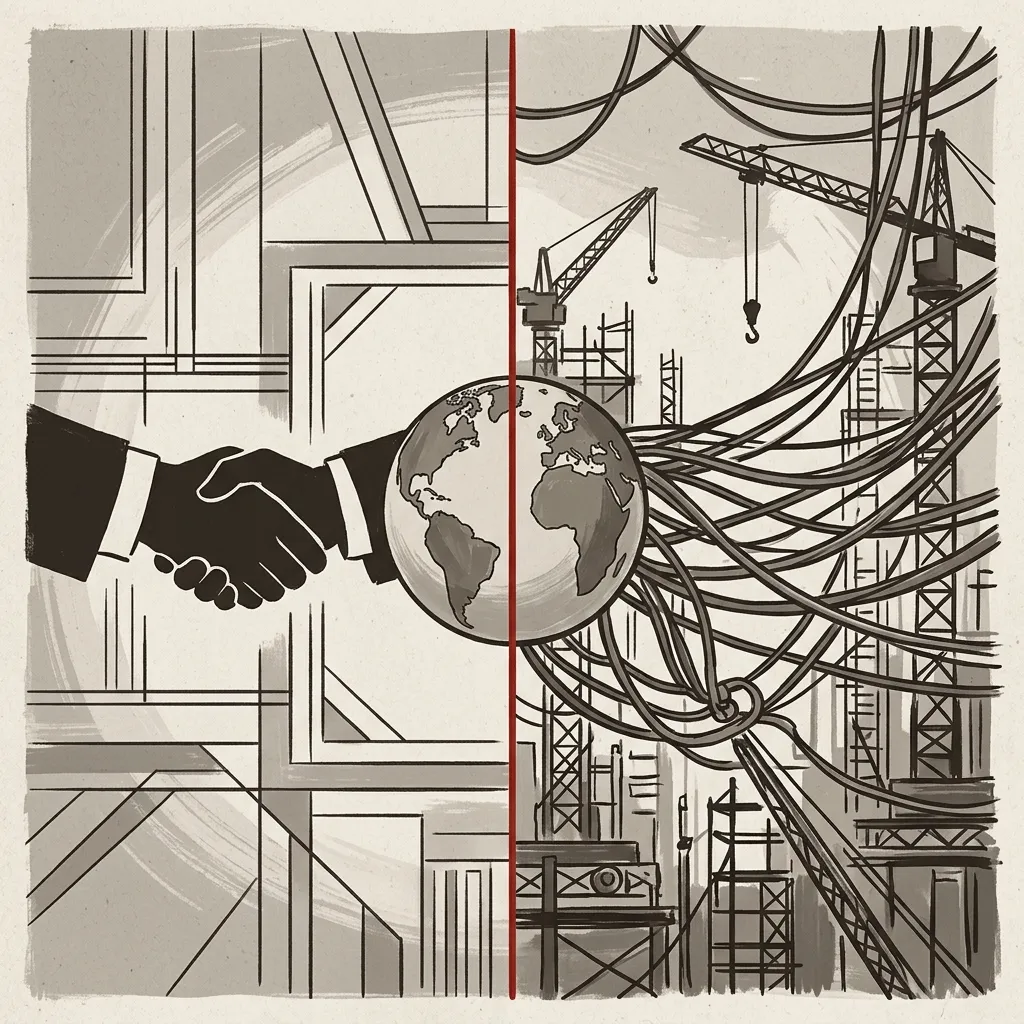
Ahead of a scheduled diplomatic visit by then-U.S. President Donald Trump to China, regional media outlets focused on markedly different aspects of the event's prelude. While one report emphasized high-level political reassurances about bilateral stability, another highlighted the conspicuous logistical preparations, illustrating divergent regional priorities in covering the same moment.
The Hindu's Framing: Diplomatic Reassurance and Strategic Stability
The Indian publication The Hindu centered its reporting on official diplomatic communications. It noted that Chinese Foreign Minister Wang Yi engaged with a bipartisan U.S. congressional delegation in Beijing prior to the presidential visit. The report framed this meeting as a signal from Chinese authorities aimed at projecting continuity in the relationship. It conveyed a Chinese perspective characterizing the bilateral ties as fundamentally stable, even while acknowledging the existence of what were described as 'disruptions.' This framing positions the visit within a broader, ongoing strategic dialogue, suggesting an effort by Beijing to manage the narrative and underscore resilience despite acknowledged points of friction. The focus is squarely on the substantive political channel, with the interaction presented as a routine but significant step in pre-summit diplomacy.
Channel News Asia's Framing: Symbolism and Spectacle of Power
In contrast, Singapore-based Channel News Asia (CNA) chose a more visually driven and symbolic angle. Its report did not mention diplomatic meetings but instead led with the sighting of heavily armored U.S. Secret Service vehicles, colloquially known as 'The Beast,' in Beijing's streets. The coverage framed these sightings as a herald for what it termed the year's most significant diplomatic event. This approach focuses on the tangible, ceremonial manifestations of power and security accompanying a U.S. presidential trip. The narrative is built around the spectacle and the symbolic weight of American protective measures operating on Chinese soil, highlighting the visit's high-stakes and high-profile nature through its logistical footprint rather than its political agenda.
Framing the Pre-Visit Narrative
The divergence in framing between these two sources is stark and reveals their distinct editorial lenses and perceived audience interests. The Hindu's coverage adopts a classic diplomatic affairs perspective, typical of mainstream Indian media's focus on geopolitical strategy and bilateral power dynamics, particularly involving major neighbors like China. The story is about words, intentions, and the official management of a complex relationship. It implicitly treats the reader as an observer of statecraft. Conversely, CNA’s report employs a lens of accessible spectacle. By focusing on the motorcade, it humanizes and dramatizes the diplomatic process, making it immediate and visual. This approach likely resonates with a broader regional audience in Asia, for whom the imagery of U.S. presidential power is a potent symbol. One narrative seeks to explain the underlying political state, while the other illustrates the event's imposing physical presence.
Synthesis of Broader Implications
Taken together, these reports illustrate how the same upcoming event can be contextualized in vastly different ways based on regional perspective and editorial focus. The Indian source’s narrative aligns with a view of international relations where stability is a carefully negotiated and asserted diplomatic condition, even amidst turbulence. The Southeast Asian source’s narrative captures the moment's theatricality and the undeniable symbolism of American executive power projecting itself into the heart of its chief strategic rival. These framings are not contradictory but complementary, offering two layers of understanding: one of diplomatic substance and stated intent, and another of symbolic performance and visible power projection. The coverage underscores that major summits are multifaceted events, interpreted through the prisms of strategic analysis in one region and symbolic spectacle in another.