
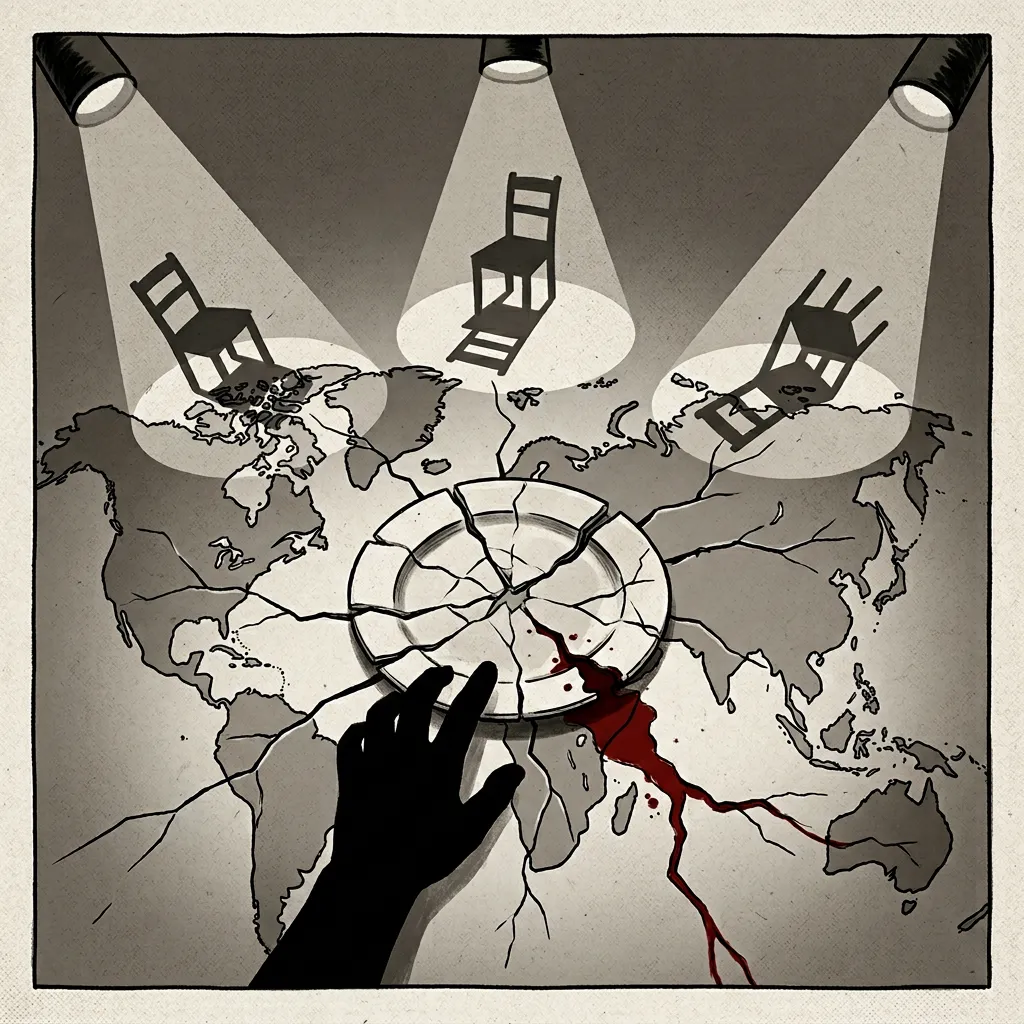
Newly released footage of an attempted assassination targeting former U.S. President Donald Trump has prompted varied reporting from international media outlets. While the basic facts of the incident—an armed individual breaching security at a Washington D.C. hotel during a high-profile dinner—are consistent, the framing of the event, the details emphasized, and the context provided differ notably across Russian, Indian, and European sources. These differences highlight divergent editorial priorities and potential regional narratives surrounding U.S. political stability and security.
RT's Detailed, Narrative-Driven Reporting The Russian state-affiliated outlet RT provides the most granular account of the incident. Its report meticulously details the sequence of events, naming the suspect as Cole Tomas Allen and specifying his age and home state. RT emphasizes the release of "high-quality CCTV footage" by the U.S. Department of Justice, describing the suspect's actions step-by-step: walking down a hallway, rushing past a metal detector, pointing a shotgun at a guard, and being engaged by security fire. A significant portion of RT's coverage is dedicated to the content of a purported manifesto left by the suspect. The report quotes the document's description of the target as "a pedophile, rapist, and traitor," while carefully noting that the manifesto did not identify Trump by name, even as it criticized his policies. This detailed, almost procedural recounting includes the specific injury to a Secret Service officer shot in the chest while wearing a vest. RT's framing presents a comprehensive, visually-supported narrative of a significant security breach.
The Hindu's Concise, Fact-Focused Approach In contrast, India's The Hindu offers a markedly brief and factual report. Its coverage is centered almost exclusively on the description of the released video evidence. The report notes the video's length—nearly six minutes—and describes its contents as featuring "several clips of a man walking back and forth down a corridor, and through a fitness centre." This description lacks the dramatic action verbs and specific threat details found in the RT report. The Hindu does not mention the suspect's name, the manifesto, the specifics of the exchange of fire, or the nature of the event (the White House Correspondents' Dinner). Its framing is minimalist, treating the story as a straightforward update on legal proceedings and evidence release, without delving into motive or broader implications.
BBC's Emphasis on Contested Facts and 'Friendly Fire' The BBC's report from Europe introduces a critical element of factual dispute absent from the other sources. While confirming the release of footage that appears to show the suspect shooting at an agent, the BBC immediately contextualizes this with the controversy over how the agent was injured. The report states the video was released "after claims that the secret service member sustained injuries in an act of 'friendly fire'." This framing shifts the focus from the assailant's actions to the performance and potential failings of the protective security detail. By highlighting this contested claim, the BBC's coverage introduces doubt and complexity into the narrative, suggesting internal scrutiny or dysfunction within the U.S. Secret Service. This angle contrasts with RT's focus on the external threat and The Hindu's neutral evidence description.
Framing the Security Breach The divergences in how these sources frame the same event are instructive. RT constructs a vivid, threat-centric narrative, emphasizing the brazenness of the attack, the ideological motive (via the manifesto), and the visceral details of the confrontation. This could be seen as amplifying a story of U.S. internal political violence and security vulnerability. The Hindu strips the event of most context and drama, presenting it as a dry administrative update, perhaps reflecting a desire to report the fact without engaging in U.S. domestic political discourse. The BBC, while less detailed than RT on the attack itself, introduces a layer of institutional critique by foregrounding the "friendly fire" allegation. This frames the story not just as an assassination attempt, but as an event that has triggered accountability questions for a key U.S. security agency.
In synthesizing these reports, the broader implication is that the significance of the event is interpreted through regional lenses. For some audiences, it is a dramatic story of political violence with clear ideological roots. For others, it is a minor news item about evidence in a criminal case. For yet others, it is a case study in the potential fallibility of elite U.S. institutions. The consistent core—a violent attempt to reach a former president—is thus wrapped in layers of additional meaning, from motive to institutional response, depending on the source's editorial stance and perceived audience interests.