
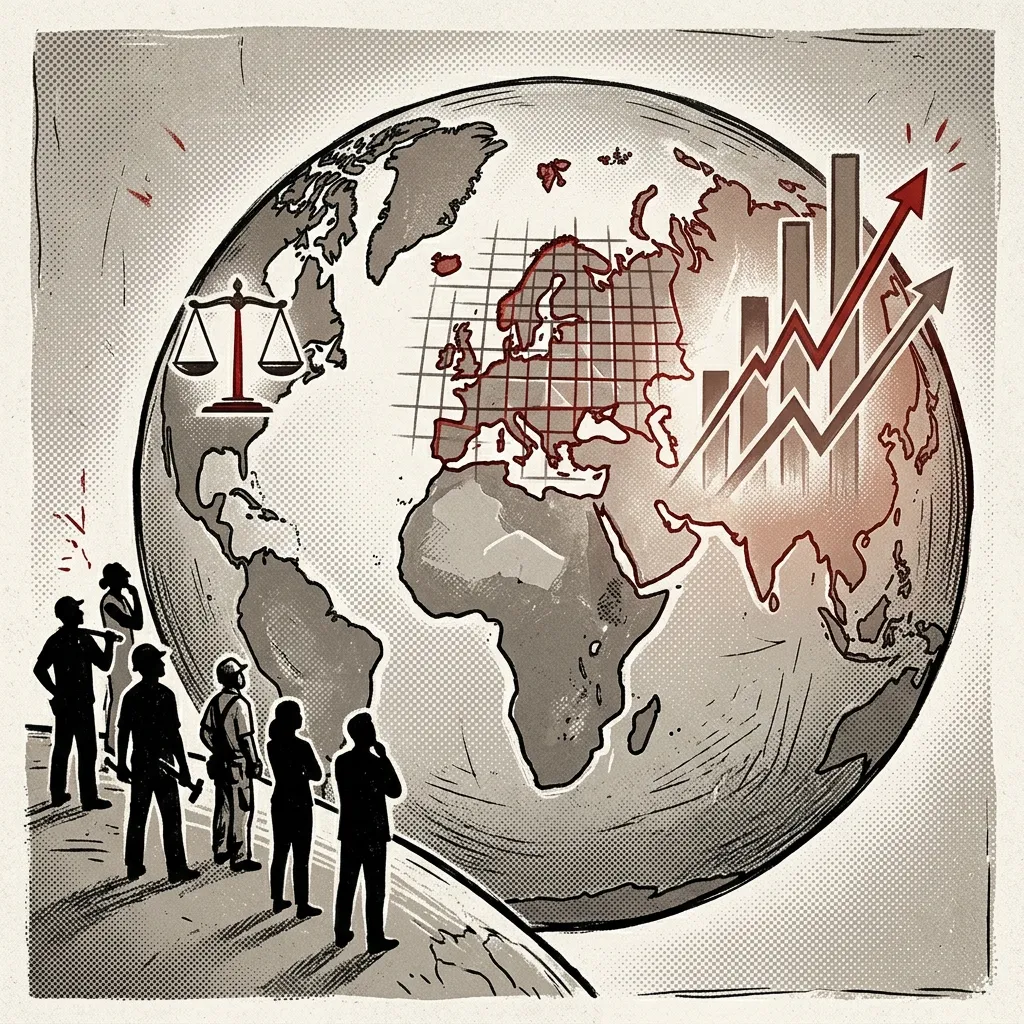
Recent developments in artificial intelligence highlight a global landscape of divergent priorities, ranging from European regulatory anxiety and Asian economic optimism to American legal settlements and United Nations-led calls for workforce adaptation. The news cycle reveals how different regions are framing the AI revolution, with narratives split between opportunity and risk, market growth and societal disruption.
European Regulatory Anxiety A report from Politico Europe frames the latest AI developments through a lens of regulatory concern. The outlet discusses a new AI model, widely understood to be from the company Anthropic, which has reportedly caused alarm within European Union institutions. The coverage suggests EU officials are "freaked out," indicating a high level of apprehension about the model's capabilities and potential implications. The narrative centers on the bloc's proactive, and sometimes anxious, stance on governing advanced AI, reflecting its established position as a leader in tech regulation aimed at mitigating societal risks.
Asian Economic Optimism In contrast, Channel News Asia presents a story centered on economic opportunity. The report details how the German semiconductor giant Infineon has raised its financial outlook for 2026, explicitly citing burgeoning demand from the artificial intelligence sector as a key growth driver. The framing is decisively positive, focusing on corporate prospects and market expansion. The report positions AI not as a source of regulatory headaches but as a powerful engine for industrial growth and profitability, particularly for a key hardware supplier in the global tech chain.
American Legal and Corporate Accountability BBC News covers a development in the United States involving consumer litigation. The report states that Apple has agreed to pay a sum of $250 million to settle a lawsuit brought by iPhone buyers. The claimants argued that the company's promotional activities for its "Apple Intelligence" features were misleading. This story frames AI advancement within a context of corporate accountability and consumer protection. It highlights the legal and commercial repercussions for tech firms whose marketing of AI capabilities may not align with user experience or expectations, presenting a narrative of checks and balances within a market-driven system.
Global Labor and Policy Imperatives The Hindu reports on a study from the International Labour Organization (ILO), a United Nations agency, which shifts the focus to the human impact of AI on employment. The ILO's analysis calls for governments to treat lifelong learning as a critical strategic priority to cushion the disruptive effect of AI on jobs. The report underscores significant gaps in current systems, noting that only 16% of workers globally received any organized training in the past year and highlighting inequalities in access to such opportunities. This framing presents AI as a force requiring major policy intervention and social investment to ensure an equitable transition and prevent the exacerbation of existing workforce disparities.
Framing the AI Narrative The regional and institutional framings of these concurrent stories create a mosaic of the global AI conversation. Europe's narrative, as seen in Politico, is one of precautionary governance and potential threat management. Asia's business-focused perspective, via Channel News Asia, highlights economic windfalls and supply-chain advantages. The American story reported by the BBC illustrates the litigious and consumer-oriented aspects of AI commercialization, where corporate promises face legal scrutiny. Finally, the ILO's perspective, covered by The Hindu, provides a macro, human-centric view concerned with long-term labor market stability and social equity, advocating for systemic policy shifts over immediate market or regulatory reactions.
Synthesis of Broader Implications Taken together, these reports illustrate that the global discourse on AI is not monolithic but is shaped by regional institutional priorities and economic positions. The EU's regulatory vigilance, Asia's embrace of AI-driven industrial growth, America's market-correcting legal mechanisms, and the UN's focus on social safeguards represent distinct, and sometimes competing, approaches to the same technological wave. This divergence suggests that the future development and deployment of AI will continue to be a site of geopolitical and economic tension, as well as a test case for global cooperation on issues like labor adaptation and ethical standards.